Storytelling and Problem-Solving: How Adventures Build Critical Thinking
Explore how storytelling builds problem-solving skills in kids — from cause-and-effect thinking to the hero's journey as a roadmap for real-life challenges.
7 min read
Storytelling and Problem-Solving: How Adventures Build Critical Thinking
Every good story is, at its heart, a problem.
Someone wants something. Something stands in the way. The question — the one that keeps us turning pages and staying up past bedtime — is: how will they figure this out?
This is as true of a picture book about a mouse trying to cross a river as it is of a sweeping novel about a young wizard discovering their destiny. The story engine is the same: problem, attempt, obstacle, attempt, obstacle, resolution. And every time a child follows a character through that engine, they are doing something that looks like entertainment but is actually something much more powerful.
They are learning to think.
Story Structure Mirrors the Problem-Solving Process
The basic structure of every story your little hero has ever loved maps almost perfectly onto the steps of effective problem-solving.
A character begins in a world they understand (the ordinary world). Then something disrupts that world and presents a challenge (the problem). The character tries to solve it, meets unexpected complications (obstacles and setbacks), adjusts their approach, and eventually finds a way through (resolution). Then the world is different — the character has changed, learned, grown.
This is not just narrative craft. It is a template for how to think through any challenge in real life.
When children hear enough stories, this template becomes internalized. They absorb, at a deep level, the idea that problems have solutions — that setbacks are part of the process, not signs of failure — that adjusting your approach when something is not working is smart, not weak — that even very difficult situations can be moved through.
These are not small things to learn. They are foundational.
Predicting Outcomes: The "What Happens If" Habit
One of the most valuable cognitive habits a child can develop is the ability to think ahead — to consider not just what is happening now, but what the consequences of different choices might be.
Stories are a continuous training ground for this habit. From the earliest picture books, children encounter moments where a character is about to make a choice, and the reader (or listener) can see where different choices might lead. Even very young children begin to do this naturally — leaning in, holding their breath, sensing that something is about to go either very right or very wrong.
When we read with children and pause to ask, "What do you think will happen if the character does that?" — we are not just building comprehension. We are explicitly practising predictive thinking. We are asking the child's brain to run simulations: if this, then what?
This is the same cognitive process that underlies good decision-making, scientific reasoning, and strategic planning. A child who has spent years predicting story outcomes is a child who has spent years practising the skill of thinking forward.
Cause and Effect Thinking
Closely related to prediction is cause-and-effect thinking — the understanding that actions have consequences, and that those consequences ripple outward in ways that can be traced and anticipated.
Stories make cause and effect visible in a way that everyday life often does not. In a story, we can see clearly: the character told a lie, and here are the specific consequences that followed. The character shared their last piece of food, and here is what changed because of that generosity. The character ignored the warning, and here is what happened next.
Life is messy and indirect. Stories are curated. That curation is not a distortion of reality — it is a clarification of the patterns within it. And children who have been reading and hearing stories are far better equipped to recognize those patterns when they encounter them outside the story world.
The Hero's Journey as a Problem-Solving Framework
You may have heard of the "hero's journey" — the narrative structure identified by mythologist Joseph Campbell, which appears in stories from cultures all around the world, across all of recorded history. The specifics vary, but the shape is always similar: an ordinary person is called to face an extraordinary challenge, must leave the familiar world behind, encounters helpers and obstacles along the way, faces a crucial test, and returns transformed.
What makes this structure so universal? Perhaps because it is not just a story pattern. It is a map of how human beings actually navigate their most significant challenges.
Think about any meaningful problem-solving process — personal, professional, or creative. There is usually a call to action (the problem presents itself). A departure from comfortable routines (you have to do something different). Helpers and resources (people and information that support you). Setbacks that require new thinking. A moment of breakthrough. And a new understanding that you carry forward.
The hero's journey is problem-solving mythologized. And when your little hero grows up inside stories that follow this shape — as the protagonist, navigating their own version of the journey — they absorb not just the emotional satisfaction of the resolution, but the underlying logic of how to move through difficulty.
Your Child as the Hero
There is something particularly powerful about stories where your child is not just watching the hero, but is the hero.
When your little hero hears a story in which a character with their name, their interests, their quirks and strengths faces a challenge and finds a way through — the lesson lands differently. It is not just, "Heroes can figure things out." It is, "I can figure things out."
That is not a small distinction. A child who has repeatedly experienced themselves as the solver of story problems develops something that is hard to overstate: the expectation that they are capable of finding a way. That when a real-life challenge arrives — and they will — there is a part of them that already knows the story arc. This is the hard part. The part where the hero has to try something new. The resolution is coming.
Interactive Storytelling and Active Problem-Solving
Not all storytelling has to be a one-way experience. Some of the richest problem-solving benefits come from storytelling that invites children to participate in the choices.
"What Should the Hero Do?"
Pausing a story at a decision point and genuinely asking your child what the character should do next is a powerful exercise. Not asking to test them — asking because you are genuinely curious what their thinking is. "The bridge is broken and the river is too wide to jump across. What do you think your hero should use?"
This invitation does several things at once. It signals that the child's thinking is valuable and interesting. It positions them as an active problem-solver rather than a passive audience. And it gives them low-stakes practice in generating creative solutions — in divergent thinking, the "what else could work?" habit that is so central to good problem-solving.
Story Choices and Consequences
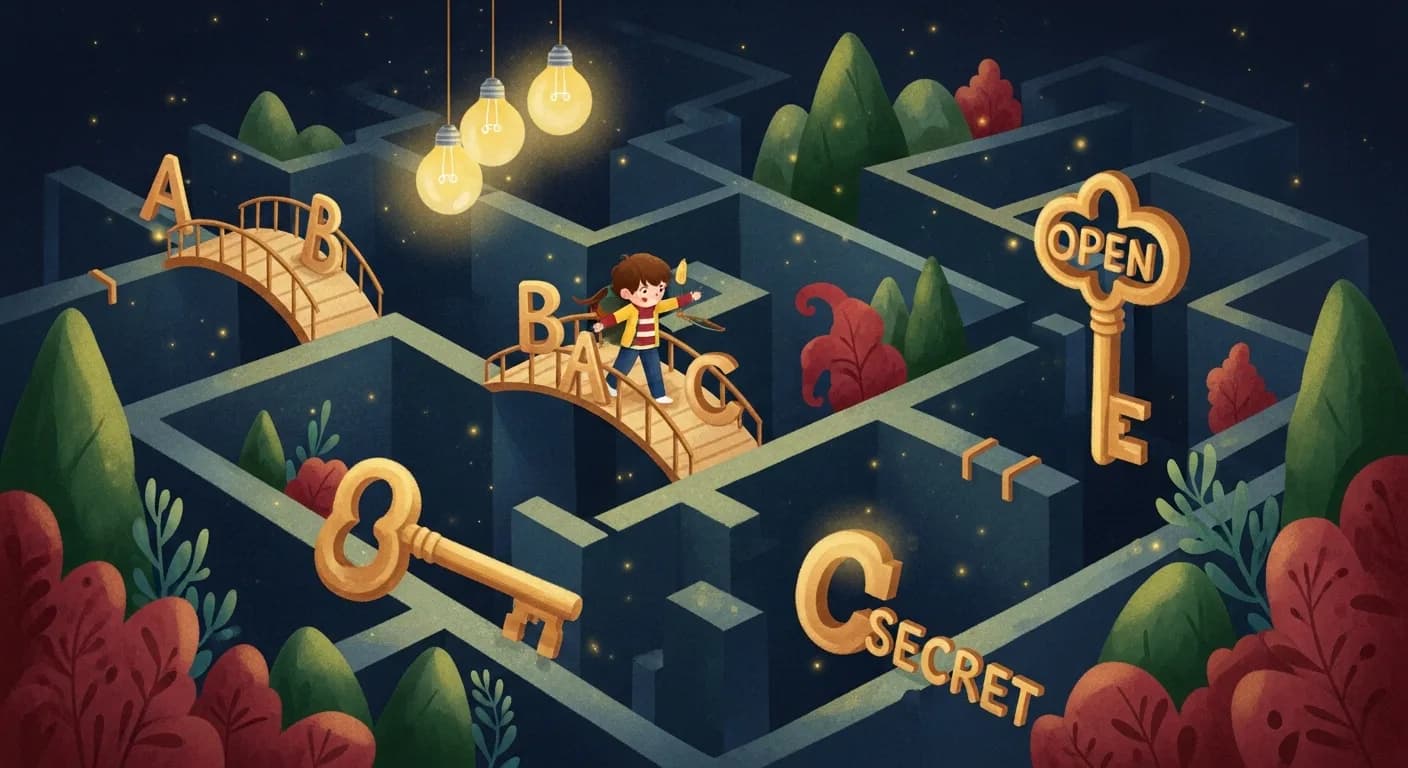
Another approach is to explicitly build branching choices into a story. "They could go left through the dark forest, or right through the flooded valley. Which way?" After the child chooses, follow the story down that path — including whatever complications that choice brings. Then, if you like, circle back: "What do you think would have happened if we'd gone the other way?"
This branching approach teaches something subtle but important: that choices have consequences, that different paths lead to different places, and that neither path is necessarily wrong — just different. This kind of nuanced thinking about choices is exactly what good problem-solving requires.
Stories and Metacognition: Thinking About Thinking
One of the higher-order skills that develops through story engagement is metacognition — the ability to think about your own thinking. When a child asks, "Why did the character do that?" or "That was a mistake — what should they have done instead?" they are not just analyzing the story. They are practicing the habit of stepping back from a situation and evaluating the reasoning within it.
Encouraging this kind of story reflection — gently, conversationally, without turning reading time into a classroom — builds genuine metacognitive skills. Children who can observe and evaluate their own thinking are dramatically better at problem-solving, because they can catch themselves when they are stuck in an unhelpful pattern and ask, "Is there another way to look at this?"
Stories give them endless practice at doing exactly that, safely, enjoyably, curled up next to someone they love.
The Stories That Build Thinkers
If you want to nurture a child who thinks clearly, creatively, and persistently through challenges, you do not need flash cards or logic puzzles (though those can be fun too). You need stories.
Stories where characters face real problems and have to genuinely think their way through them — not just stumble onto a solution, but puzzle, attempt, fail, adjust, and try again. Stories where the resolution feels earned because it was. Stories where your little hero can see themselves in the character who figured it out.
The habit of solving story problems quietly becomes the habit of solving real ones. The expectation that even hard things have a way through, learned from a hundred bedtime adventures, becomes the confidence that carries a child forward when life presents its own unexpected challenges.
Every adventure your child lives through in a story is practice for the adventures they will navigate in the world.
Give your little hero a personalized adventure that puts them right at the center of the problem-solving journey. At OnceUponMe.com, stories are crafted around your child — their name, their personality, and the kinds of challenges they love to conquer.
Keep exploring: