Nurturing Your Child's Imagination Through Storytelling
Discover how storytelling builds imagination as a lifelong skill in children — and simple ways to spark creative thinking through stories every day.
7 min read
Nurturing Your Child's Imagination Through Storytelling
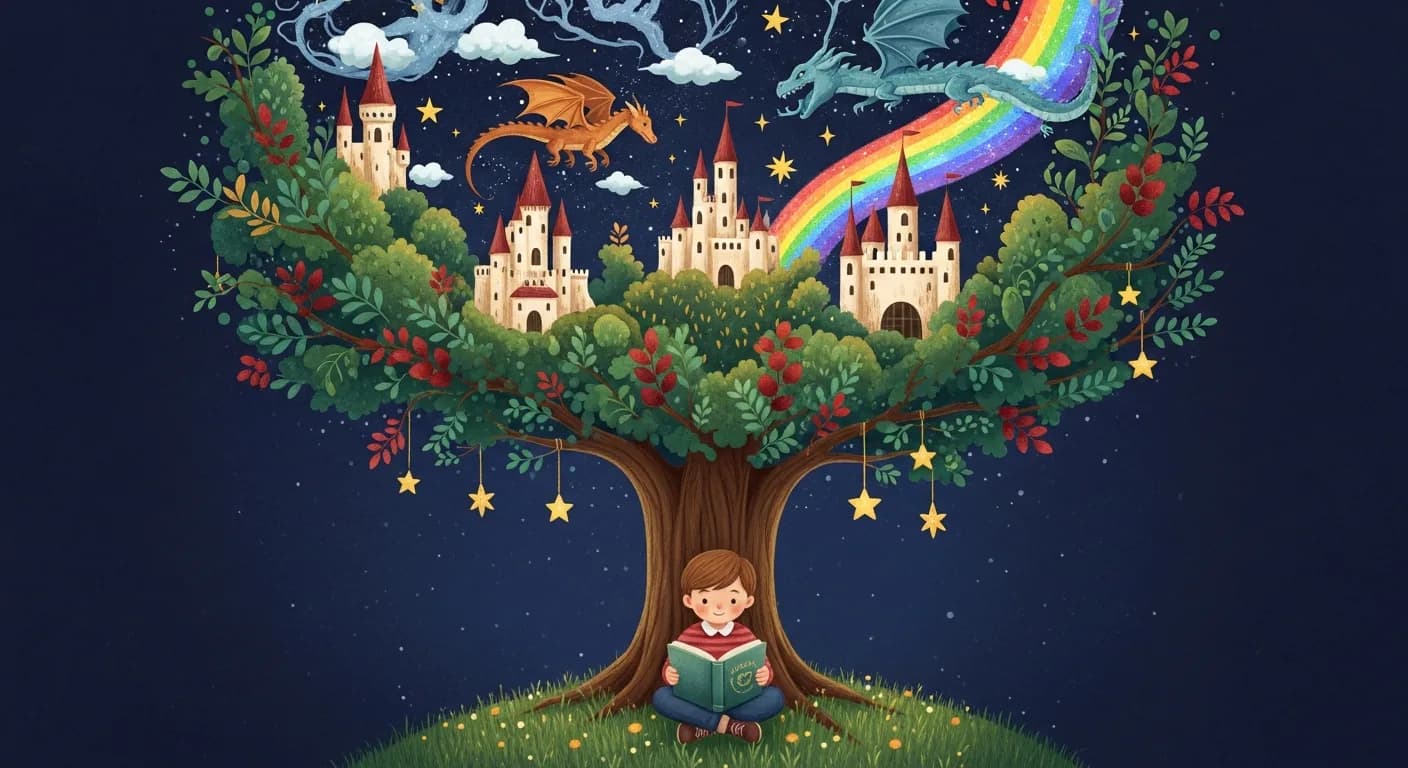
There is a moment — you have probably seen it — when a child completely disappears into a story. Their eyes go wide. Their breath slows just a little. The real world fades out, and somewhere inside that small, wonderful head, a whole other world is lighting up. Dragons are circling mountains. A tiny mouse is crossing a vast ocean on a paper boat. A child who looks a lot like your little hero is standing at the edge of a great adventure.
That moment is not just magic. It is work. Beautiful, invisible, deeply important work.
Because imagination is not something children either have or do not have. It is a skill — one that grows stronger every time it is exercised, every time a story asks a child to picture something they have never seen and believe in it completely.
Imagination Is a Skill, Not a Gift
We tend to talk about imaginative children as though they were born that way — as if some kids arrived with extra helpings of creativity while others drew the practical card. But research on cognitive development tells a different story.
Imagination — the capacity to form mental images of things not present, to envision possibilities, to think beyond what is directly in front of us — is built through experience. And one of the richest experiences for building it is, quite simply, hearing stories.
When your little hero listens to a tale, their brain does not sit back passively. It assembles. Every detail you give it — "the forest smelled like pine and cold rain," "the dragon had scales the color of embers" — becomes raw material. The brain fills in the gaps, invents the parts the story does not say, and constructs a living scene. That is imagination flexing its muscles.
The more stories a child hears, the more building material they accumulate. The more varied those stories — different settings, different characters, different kinds of problems — the more versatile and elastic their imaginative capacity becomes.
How Stories Build Mental Imagery
Think about what happens when you read your child a picture book versus when you tell them a story with no pictures at all.
With pictures, some of the imaginative work is done for them. The illustrator has already decided what the wolf looks like, how the grandmother's cottage sits in the clearing. That is wonderful — and there is real value in learning to read visual narrative. But when the pictures disappear, something remarkable happens: your child's mind steps in as illustrator.
Purely verbal storytelling — whether read aloud, told from memory, or improvised on the spot — requires a child to construct the entire visual world themselves. This is enormously good cognitive exercise. It develops what psychologists call "mental imagery," the ability to create and manipulate pictures in the mind. This skill underpins everything from reading comprehension to mathematical reasoning to creative problem-solving.
You do not need to be a professional storyteller to give your child this gift. A bedtime story told with no book at all — even a rambling one, even one you are making up as you go — is exercising your child's imagination in ways a screen or a heavily illustrated book simply cannot match.
The Role of Gaps and Uncertainty
Here is a storyteller's secret: the parts of a story you do not describe are often the most powerful.
When you say, "And then, deep in the forest, your little hero heard a sound," and you pause — that pause is doing extraordinary work. Your child's brain rushes in to fill the silence. What kind of sound? What does the forest look like at that moment? What does it feel like to be standing there?
That moment of imaginative filling-in is where creativity lives. Good stories leave room for the listener's mind to participate. They invite rather than dictate. The child becomes not just an audience but a co-creator of the story — and that is where imagination truly grows strong.
The Connection Between Storytelling and Creative Play
Have you ever noticed that children who love stories tend to have richer imaginative play?
This is not a coincidence. Stories and play speak the same language. Both involve entering an alternative reality, sustaining belief in something imagined, and navigating a world with its own internal logic. When your little hero plays "dragon riders" after hearing a story about dragons, they are not just playing — they are storytelling in motion.
The narratives children hear become the raw material of their play. A child who has been exposed to stories about ocean voyages will build more elaborate ships from sofa cushions. A child who has heard stories about small creatures solving big problems will bring more nuance and cleverness to their games of pretend.
This is why the variety of stories we offer children matters. When we expand the worlds they have visited in their imaginations — through folktales from different cultures, stories set in different times and places, tales with heroes who are animals, elders, children, giants, mice — we expand the palette they have to paint their own imaginative play.
Divergent Thinking: The Imagination Superpower
Educators and psychologists often talk about "divergent thinking" — the ability to generate many possible solutions to a problem, to think in multiple directions at once, to ask "what if?" rather than just "what is?"
Divergent thinking is closely tied to creativity and innovation. It is the quality that lets someone look at a challenge and see ten possible approaches instead of one. And storytelling is one of the most natural and effective ways to develop it.
Stories are full of divergent thinking in action. A character faces a problem and must find a way through. The solution often requires lateral thinking — using an unexpected object, forming an unlikely alliance, seeing the situation from a completely different angle. When children hear these solutions modeled over and over, they begin to internalize the habit of asking, "What else could work here?"
Better still: interactive storytelling actively invites children to contribute divergent thinking themselves. When you pause a story and ask, "What do you think your hero should do now?" you are explicitly exercising that muscle. There are no wrong answers. The story can go anywhere. And your child learns, deeply, that their imagination is a reliable and powerful tool.
Practical Storytelling Activities to Spark Imagination
You do not need a formal curriculum or a dedicated "story time" block. Imagination grows in the small moments. Here are some ideas for weaving imaginative storytelling into everyday life.
The "What Happens Next?" Game
Tell a story for a few minutes, then stop at a moment of suspense or decision. Hand it to your child: "What do you think happens next?" Let them continue the story. No corrections, no redirections — just enthusiastic follow-up questions. "Oh wow, and then what did the talking fox do?" This game works in the car, at the dinner table, on a walk.
Reverse Storytelling
Ask your child to tell you a story, but set one simple rule: something impossible must happen. A dog who can fly. A school made entirely of cake. A rainstorm that rains lemonade. This "impossible rule" gives children permission to abandon realistic constraints and dive straight into imaginative territory.
Story Starter Jars
Write story opening lines on slips of paper and put them in a jar. Pull one out at random and take turns adding to the story. "One morning, a small purple cloud floated in through the kitchen window and refused to leave." Where does your child's imagination take that?
Personalized Stories with Your Child as the Hero
There is something uniquely powerful about a story in which your child is the main character. When your little hero hears their own name, sees their own world reflected in the story — their bedroom, their dog, their favourite colour — the imaginative connection deepens. The line between "story world" and "my world" blurs in the most wonderful way.
Stories where children see themselves as the hero do not just entertain. They tell a child something important: you belong in adventures. Your imagination is a place worth visiting. You are someone stories get told about.
That is the real gift of storytelling for imagination — not just the skill of building mental pictures, but the conviction that the world inside your mind is a rich and worthy place.
A Story-Filled Childhood Is a Creative Adulthood
The children who grow up surrounded by stories — who learn to build worlds inside their heads, to ask "what if," to inhabit other perspectives, to find their way through a narrative problem — carry those capacities forward.
They are the adults who can hold an unfamiliar idea without panic. Who can see beyond the obvious solution. Who can communicate with warmth and vividness. Who can sit with uncertainty long enough to find something creative on the other side.
Imagination, nurtured through storytelling, is not a luxury. It is a foundation.
And it starts with something as simple as settling in beside your little hero, opening a book or just opening your mouth, and saying: "Once upon a time..."
Want to give your child a story they will never forget — one where they are the hero? Explore personalized stories at OnceUponMe.com, where every tale is crafted around your child's name, traits, and the things they love most.
Keep exploring: