How Storytelling Shapes Your Child's Brain: A Parent's Guide
Discover how storytelling literally rewires your child's developing brain—building language, empathy, and executive function one bedtime story at a time.
7 min read
How Storytelling Shapes Your Child's Brain: A Parent's Guide
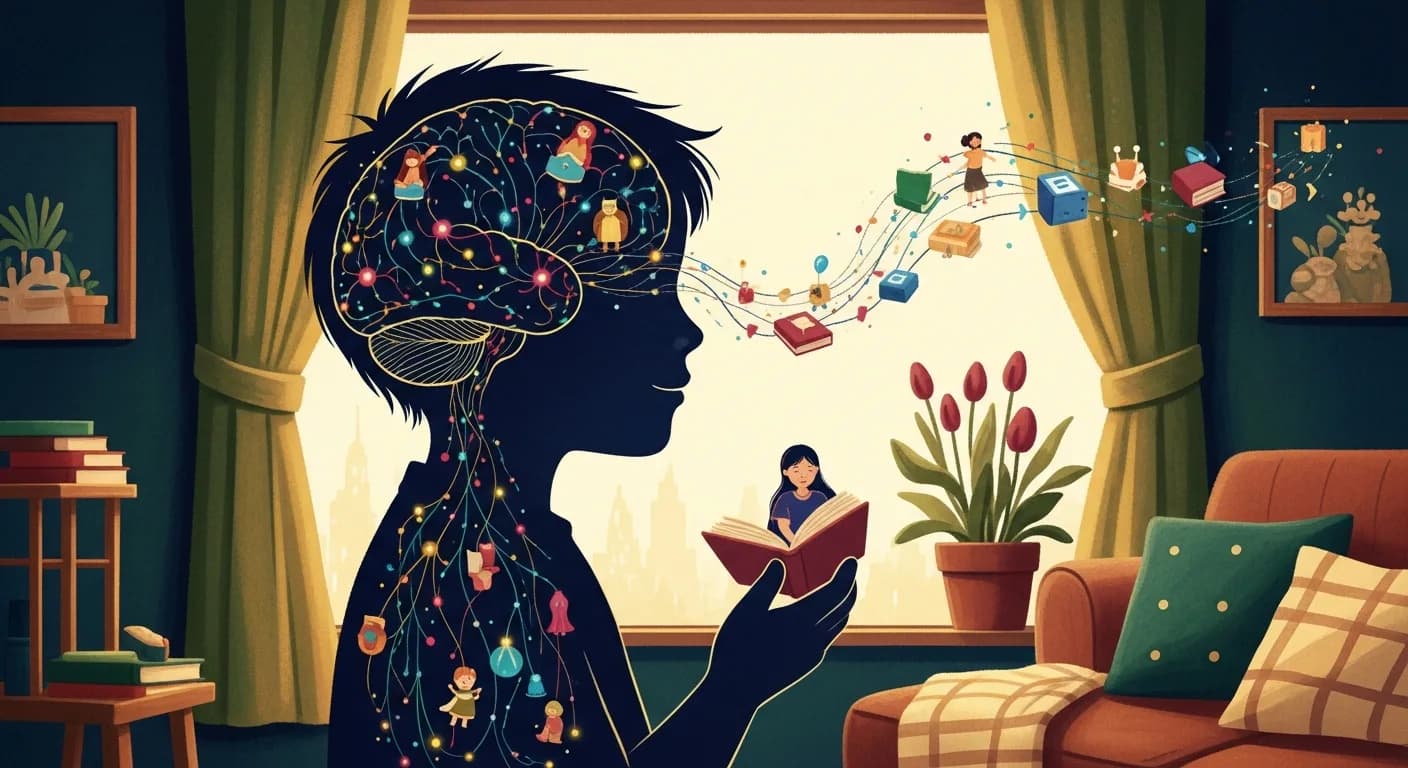
There is a moment, somewhere between "once upon a time" and the final page, when something remarkable happens. Your little hero snuggles in close, their eyes go wide, and the whole busy world falls away. You might think you are simply reading a bedtime story. But inside that small, extraordinary head, a symphony is playing.
Stories are not just entertainment. They are, quite literally, the way human minds learn to understand the world. And the time you spend reading aloud, spinning tales at the dinner table, or inventing adventures on long car rides? It is building your child's brain in ways that no flashcard, no app, no worksheet can replicate.
Here is what the science tells us — and what every parent already knows in their heart.
The Brain Lights Up Differently for Stories
When we process a list of facts, our brains activate the language areas and not much else. But when we hear a story — a real, vivid, character-driven story — something completely different happens. Brain imaging studies show that narratives activate the sensory cortex, the motor cortex, the emotional centers, and the areas responsible for social understanding, all at once.
Neuroscientists call this neural coupling: the brain of the listener begins to synchronize with the brain of the storyteller. When a child hears you describe a character racing through a dark forest, the parts of their brain that process real movement and real darkness flicker to life. The story becomes, neurologically speaking, an experience.
For a developing brain, this is profound. Every story your child hears is a low-stakes rehearsal for life — a chance to feel things, process things, and understand things before they ever have to face them alone.
Language Networks: Stories Build the Architecture of Words
Long before children can read, they are building language networks — intricate webs of meaning, grammar, and expression that will carry them through life. Storytelling is the richest possible fuel for this process.
When your little hero hears stories, they are not just picking up individual words. They are absorbing how sentences flow, how ideas connect, how tension builds and resolves. They are learning that language is alive — that it can make you laugh, make you cry, make your heart beat faster.
Children who are read to regularly enter school with vocabularies that are thousands of words larger than those who are not. More importantly, they understand how to use those words — in conversation, in writing, in thought. The words do not sit in isolation. They live inside stories, breathing and meaningful.
Theory of Mind: Stories Teach Children That Other People Think
One of the most astonishing things a child ever learns is this: other people have minds of their own. Other people have feelings, desires, fears, and beliefs that are different from their own. Psychologists call this theory of mind, and it is the foundation of empathy, friendship, and human connection.
Stories are a theory of mind gymnasium.
Every time your child follows a character through a story — wondering what the dragon is thinking, feeling the princess's fear, understanding why the villain made such a terrible choice — they are practicing the profound skill of inhabiting another perspective. They are learning that the world does not begin and end with themselves.
Research consistently shows that children who are exposed to rich narrative fiction develop theory of mind earlier and more robustly than those who are not. They are better at reading facial expressions. They are more likely to understand why a friend is upset. They navigate the complex social world of childhood with greater ease and grace.
Stories and the Emotional Brain
Closely linked to theory of mind is emotional development. Stories give children a safe container for enormous feelings. When the beloved pet in a picture book dies, a child can grieve alongside the character — processing loss in a space where they feel held and safe. When the underdog hero fails and tries again, a child learns something true and important about resilience.
These are not small gifts. The emotional vocabulary a child builds through stories — the ability to name, recognize, and navigate their own inner world — is one of the most powerful predictors of wellbeing across their entire life. You can read more about this in our piece on how stories teach children to understand emotions.
Executive Function: The Hidden Gift of "What Happens Next?"
Here is one that surprises many parents: storytelling builds executive function.
Executive function is the cluster of mental skills that allows us to plan, focus, remember instructions, and juggle multiple tasks. It is also one of the best predictors of long-term academic success — even more than IQ. And stories, it turns out, are one of the best ways to develop it in early childhood.
When a child follows a narrative, they are holding the beginning of the story in mind while processing the middle, and anticipating what might come next. They are tracking multiple characters, keeping cause-and-effect chains alive in working memory, and constantly updating their understanding as new information arrives.
This is cognitive work — deeply engaging, genuinely challenging cognitive work that feels to the child like pure pleasure.
The Magic of "What Do You Think Will Happen?"
You can turbocharge this effect with a single question asked mid-story: What do you think will happen next?
That pause, that moment of wondering, asks your child to reach into the story, gather up everything they know, and project forward. It builds predictive reasoning, causal thinking, and narrative comprehension all at once. And it makes the story feel like a game — which, for a young brain, is exactly what learning should feel like.
How Personalized Stories Amplify Every Effect
Everything we have explored so far — neural coupling, language development, theory of mind, executive function — is amplified when the story feels personally relevant to the child.
When your little hero is the main character, something shifts. Their attention sharpens. Their emotional investment deepens. The neural coupling becomes even more intense because the brain is not just imagining a character — it is imagining itself.
This is not just a warm feeling. Research on self-referential processing shows that information connected to our own sense of self is processed more deeply and remembered more durably. A child who hears their own name in a story, who sees their own interests and personality reflected back in a character, is engaging every one of these developmental mechanisms at full power.
At OnceUponMe, every story puts your child at the center of the adventure — because we know that the most powerful story a child can hear is the one in which they are the hero.
The Long Arc: Stories Are Never "Just" Stories
It is easy to feel, in the rush of daily life, that reading aloud is a nice extra — something lovely to do when there is time, but not truly essential. The science, and every wise storyteller across human history, pushes back firmly on this.
Stories are how we transmit culture, values, and wisdom. They are how children learn what it means to be brave, kind, curious, and resilient. They are how we show our children the full range of what it means to be human — the joys and the sorrows, the mistakes and the comebacks.
A child who grows up surrounded by rich storytelling is not just a better reader. They are more empathetic, more imaginative, more emotionally intelligent, and better equipped to navigate the inevitable difficulties of life. They carry, inside them, a library of human experience to draw from.
What You Can Do Starting Tonight
The research points to one beautifully simple conclusion: tell your children stories. Read to them every day, for as long as they will let you. Invent adventures together. Ask them to tell you stories back. Fill their world with narrative, character, and wonder.
And on the nights when you are tired and the right story does not come to mind, remember that a short, imperfect story told with love does more good than no story at all.
Your little hero is listening. Their brain is building. And every single word you share is becoming a permanent part of who they are.
Keep Exploring
The story of how stories shape children is a rich one. Dive deeper with these related reads:
- Reading Aloud to Your Child: Benefits at Every Age — because the right story at the right age makes all the difference
- How Stories Teach Children to Understand Emotions — a closer look at emotional intelligence and narrative
- Why Storytelling Builds Vocabulary Faster Than Flashcards — the science of contextual language learning
Ready to put your little hero at the center of the story? At OnceUponMe, we craft personalized tales that are as unique as your child — because every great adventure deserves a great hero. Start your story today.