How Stories Help Children Develop Empathy
Learn how storytelling builds empathy in children by teaching perspective-taking, kindness, and emotional understanding — one story at a time.
6 min read

How Stories Help Children Develop Empathy
Ask any parent what they most want for their child — beyond the obvious gifts of health and happiness — and somewhere in the list, usually, you will find some version of this: I want them to be kind.
Kindness is not just a character trait. It is a capacity. And like most capacities, it is built gradually, through experience, through practice, through encounters — real and imagined — with other people's inner lives.
Stories are one of the oldest and most powerful tools we have for building that capacity. Long before the word "empathy" existed, storytellers understood something essential: that the act of inhabiting another perspective — of climbing inside a character's experience and feeling it alongside them — changes you. It expands the circle of who you consider.
Here is how it works, and why the stories we tell our children matter more than we might think.
What Empathy Actually Means for Children
Empathy is often described simply as "putting yourself in someone else's shoes." That is a good start, but the full picture is a little more interesting.
Psychologists distinguish between two kinds of empathy. Cognitive empathy is the ability to understand what another person is thinking or feeling — to model their mental state from the inside. Affective empathy is the ability to actually feel something in response to another person's experience — to be genuinely moved by their joy or their pain.
Both matter. And both are developed, not innate.
Children are born with the seeds of empathy — infants respond to the distress of other infants, toddlers offer comfort to people who seem upset. But the capacity to extend empathy beyond the immediate and familiar — to people who are different, in situations that are unfamiliar, experiencing feelings your child has never personally felt — that takes cultivation.
Stories are extraordinarily good at cultivating it.
Perspective-Taking: Walking in Someone Else's Shoes
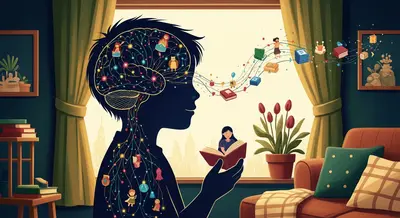
When your little hero listens to a story, something remarkable happens neurologically. The brain does not process narrative the way it processes, say, a list of facts. It simulates the experience. Neural systems associated with movement, sensation, and emotion light up as the brain tracks the character's experience. In a very real sense, your child is not just hearing about the character — they are living alongside them.
This is what researchers call "narrative transportation" — the experience of being drawn into a story world so completely that you take on the perspective of the characters within it. And it turns out that narrative transportation is one of the most reliable pathways to genuine perspective-taking.
When your child follows a character through a frightening forest, they feel something of the fear. When they cheer as the character finds courage, they share the relief. When a character is left out, misunderstood, or afraid of something others do not understand — your child sits with that discomfort too.
That experience — repeated across hundreds of stories, across many different characters and situations — teaches the brain a habit: to ask, "What might this feel like for someone else?"
The Invisible and the Distant
One of the most valuable things stories can do is make the invisible visible.
Your child can have direct empathy for someone they can see crying. But how do they develop empathy for someone whose pain is not visible — a child who feels lonely in a crowd, a grandparent who misses something from long ago, a friend who hides their fear behind jokes?
Stories give us access to interiority — to the inside of a character's experience in a way real life rarely does. We hear the character's thoughts. We know what they noticed, what they hoped for, what they were afraid to say. We understand things about the character that the other characters in the story do not.
This "privileged access" to another's inner life is something stories offer that almost no other experience can. And it quietly teaches children a profound truth: the people around you have rich inner lives that you cannot see from the outside. What looks small on the surface may be enormous underneath.
Diverse Stories Expand the Circle of Empathy
Empathy naturally extends most easily to people who seem similar to us. That is human nature, but it is also a limitation — one that can be gently, lovingly expanded through the stories we choose.
When your little hero hears stories featuring children who look different from them, live in different places, come from different family structures, face different challenges — something quietly shifts. The circle of "people like me, whose feelings matter" grows.
Research in developmental psychology has consistently found that exposure to diverse narratives — stories featuring characters from different cultural backgrounds, abilities, family configurations, and life experiences — is associated with greater social tolerance and perspective-taking in children. It is not a lecture about diversity. It is something much simpler and deeper: familiarity breeds compassion.
This is why the range of stories we offer children matters just as much as the quality of any individual story. A childhood rich in stories from many different vantage points is a childhood spent expanding the imagination's circle of care.
Stories About Feeling Different
A particularly powerful category of empathy-building story is one in which a character experiences feeling different, left out, or misunderstood — and finds their way through it.
These stories do double duty. For a child who has felt that way, they offer the deep comfort of recognition: someone else has felt this, and it was okay, and there is a way through. For a child who has not yet felt that particular kind of pain, they offer a window: this is what it feels like, and it matters, and kindness here would mean something.
Both children come away more empathetic — one toward themselves, one toward others.
Research on Narrative Empathy: What the Studies Say
The connection between stories and empathy is not just intuitive — it is increasingly well-supported by research.
Studies have found that children who are read to regularly score higher on tests of social cognition — the ability to understand other people's thoughts and feelings — than children with less exposure to narrative fiction. Researchers have proposed that fiction serves as a kind of "social simulator" for the brain, allowing us to safely practice navigating complex emotional and social situations without real-world stakes.
One influential body of research, associated with psychologist Raymond Mar and novelist Keith Oatley, has explored "narrative empathy" — the idea that engaging with fiction is a primary mechanism through which humans develop and maintain empathic capacity. Their work suggests that the more fiction a person reads across their life, the better they tend to be at understanding and responding to other people's emotions.
This research is mostly conducted with adults, but the developmental implications are clear: the habits of empathic imagination we build through stories in childhood compound over time. The child who grows up reading and hearing rich, varied stories is building a foundation for a lifetime of genuine connection.
Age-Appropriate Approaches to Empathy Through Stories
Empathy develops in stages, and the kinds of stories that build it best shift as children grow.
Toddlers and Early Preschool (Ages 2–4)
At this age, emotional recognition is the primary goal. Simple stories that name and show feelings — the character feels sad, then someone helps, and then they feel better — are enormously valuable. Cause-and-effect emotional sequences ("When nobody saved her a seat, Maya felt left out") help young children begin to map the connection between actions and feelings.
Preschool to Early Primary (Ages 4–7)
Children at this stage are developing the capacity for genuine perspective-taking. Stories that explicitly show the inside of a character's experience — their thoughts, their hopes, their fears — work well here. Asking "How do you think she felt when that happened?" after a story moment is a natural and low-pressure way to practise perspective-taking together.
Middle Childhood (Ages 7–10)
Older children can handle more complex emotional landscapes — characters with mixed feelings, situations without easy resolutions, perspectives they may find challenging. Stories featuring moral complexity, where "doing the right thing" is not straightforward, invite the kind of nuanced empathic thinking that will serve them well as they navigate a complicated world.
What You Can Do Tonight
You do not need a curriculum to raise an empathetic child through stories. You need a book, a lap, and a willingness to pause.
Ask questions as you read. Not testing questions — wondering questions. "I wonder how she felt right then." "What do you think he was thinking when that happened?" "Have you ever felt something like that?"
Let your child answer however they need to. Let them sit with the discomfort of a sad story without rushing past it. Let them cheer for a character who is finally understood.
And if you want to give your little hero a story in which they get to be the one who is brave, kind, and heroic — where the adventure is shaped around who they are — those stories have a particular magic all their own.
Because when a child sees themselves as the hero of a story, they begin to believe it in the deepest way: they are someone capable of empathy, of courage, of making the world better by being in it.
Ready to create a story that puts your child at the heart of the adventure? At OnceUponMe.com, every story is personalized around your child — their name, their world, their character.
Keep exploring: