Screen Time vs. Story Time: Finding the Right Balance
Screen time vs. story time doesn't have to be a battle. Here's how to find a balance that works for your family — without guilt or rigid rules.
7 min read
Screen Time vs. Story Time: Finding the Right Balance
Let us get something out of the way right at the start: this is not an article about how screens are bad.
Screens are not bad. They are tools. Extraordinary, powerful, endlessly varied tools — and like all tools, what matters is how we use them, not the tools themselves. A documentary about deep-sea creatures is a screen. A video call with a grandparent who lives across an ocean is a screen. A silly cartoon that makes your child belly-laugh on a rainy afternoon is a screen.
None of those things are problems.
But there is something that story time offers — something particular, irreplaceable, and worth protecting — that tends to get quietly squeezed out when screens fill every available gap. And understanding what that something is makes it much easier to find a balance that actually feels good, rather than one built on guilt and restriction.
What Screens Do Brilliantly
Let us start with an honest accounting of what screens offer children, because they offer quite a lot.
Visual learning. Children who struggle with text-heavy content often thrive with visual media. Educational videos, interactive apps, and documentaries can make complex ideas accessible and engaging in ways that a book cannot always match.
Connection and presence. Video calls with loved ones, shared viewing experiences with family, the cultural touchstones that children share with their peers — screens facilitate real social connection.
Creative tools. Drawing apps, music-making tools, stop-motion animation — screens can be extraordinarily generative. A child who makes a digital comic strip or records a song is not consuming; they are creating.
Rest and recovery. Sometimes a tired child (or a tired parent) just needs to watch something calm and enjoyable. That is not laziness — it is rest, and it is legitimate.
The point is not to make screens into the villain of this story. The point is to understand what they provide — so that we can also clearly see what they do not.
What Story Time Provides That Screens Cannot Replicate
When we talk about "story time," we mean the full range of experiences: books read aloud together, stories told from memory, audiobooks listened to at bedtime, and personalized stories crafted around your child's own life and name. What these experiences share is something that passive screen consumption does not offer in the same way.
Imagination Without a Picture
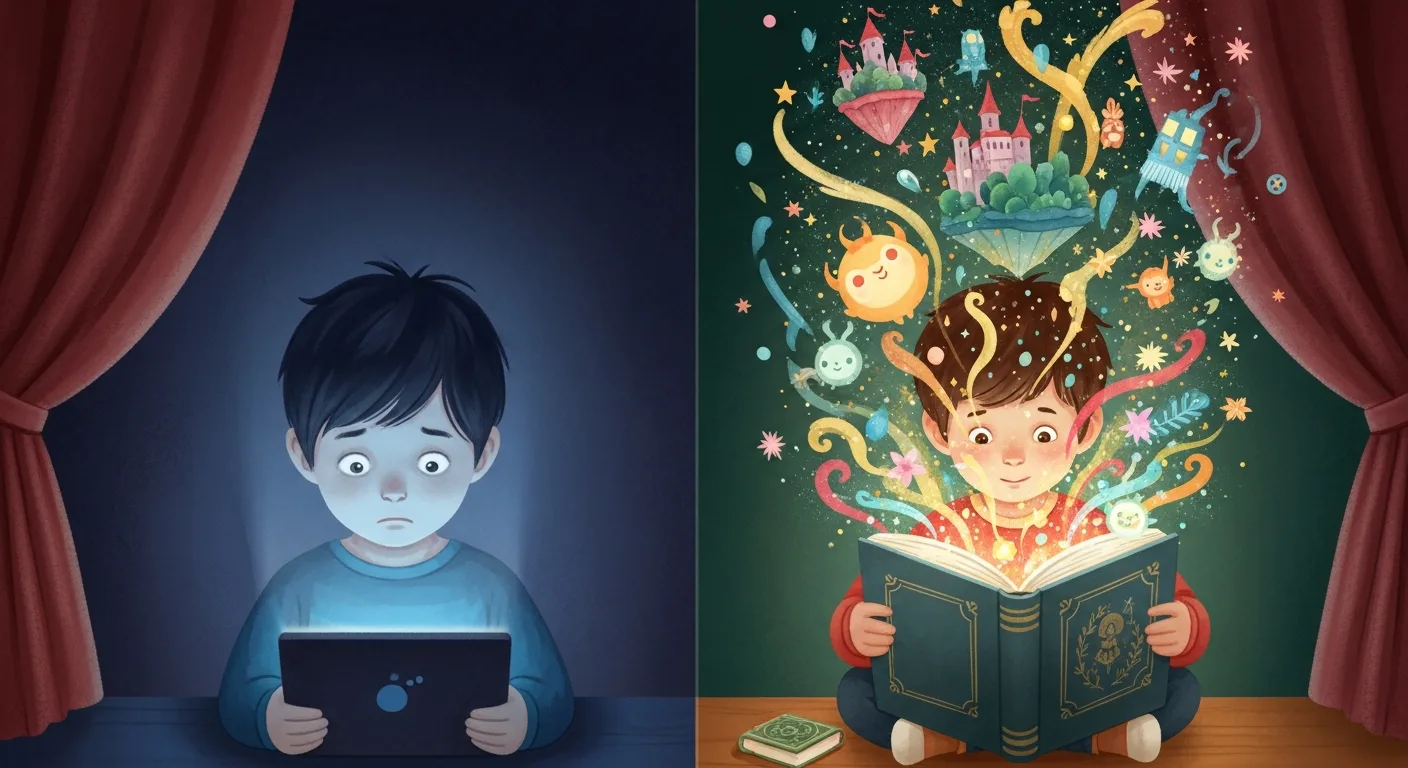
When your little hero watches a story on a screen, the visual world is fully constructed for them. When they hear or read a story, they construct the world themselves.
This distinction matters far more than it sounds. The act of building a mental picture — imagining what the forest looks like, what the dragon's voice sounds like, what the character's face does in the moment of fear — is active cognitive work. It develops visual imagination, spatial reasoning, and the capacity for complex mental simulation.
This is a skill that has to be exercised to grow strong. And the primary way it grows is through stories where the child's mind does the work, not the screen.
The Pace of Language
Screens generally move fast. Even thoughtful, high-quality programming is edited to maintain visual momentum. This is not inherently harmful, but it is different from the pace of a story told or read aloud — a pace set by a human voice, by a child's attention, by the natural rhythm of language.
When a child listens to a story being read aloud, they are immersed in the full richness of written language: complex sentence structures, vivid vocabulary, narrative pacing that builds and releases tension. Research consistently shows that reading aloud to children — even well past the age when they can read independently — significantly expands vocabulary, comprehension, and the internalized sense of how language works.
Screens can carry language too, of course. But the density and complexity of written narrative read aloud is typically richer than scripted dialogue, and the pace is naturally more contemplative.
The Presence of Another Person
There is something that happens in shared story time that does not happen in solo screen time: co-presence.
When you read to your child, you are sharing a world with them. You pause to wonder together. You exchange a glance at a funny moment. Your child reaches over to point at something on the page, or asks a question that leads somewhere neither of you expected. The story is the occasion for connection — but the connection itself is the thing of lasting value.
Research on reading aloud consistently shows that the social and emotional experience of shared reading — not just the text itself — is a significant contributor to children's language development, attachment security, and love of books. The physical closeness, the warmth of a voice, the sense of being together inside a story — these are not incidental. They are central.
A screen in the hands of a child alone does not offer that. It can be entertaining, even educational. But it cannot replicate being held inside a story by someone who loves you.
Audio Stories: The Bridge Between Story Time and Screen Time
If you are looking for a way to expand your child's story diet without adding more screen time, audio stories are one of the most underutilized tools available.
Audiobooks and audio stories offer almost everything that read-aloud story time provides — rich language, imaginative engagement, narrative immersion — without requiring the child to sit still with a book or a screen. They work beautifully in the car (famously good for long journeys with restless children). They can play at bedtime when eyes are already too heavy for pages. They can accompany creative play, Lego building, or drawing — activities where a child's hands are busy but their ears and imagination are free.
Well-produced audiobooks, with skilled narrators who bring characters to life, are a particular joy. For children who resist sitting still for a traditional read-aloud, audio stories can be a revelation: a story can live in the air of a room, not just on a page or a screen.
Personalized audio stories — ones where the story is crafted around your child's own name, interests, and world — bring this experience to an entirely different level. When your little hero hears their own name spoken aloud in the context of an adventure, something in their imagination catches fire.
Practical Family Media Strategies: Balance Without Battle
Here is a gentle truth: rigid screen time rules that feel like punishment tend to backfire. Children who are told screens are forbidden often fixate on them more intensely. Rules that create conflict around media become battles, and battles are exhausting for everyone.
What tends to work better is building a life rich enough in other kinds of experiences that screens find their natural place in it — neither forbidden nor dominant.
Anchor the Day with a Story
Before screens enter the picture in the morning, start with a short story. Even five or ten minutes — a chapter of a book, a story told over breakfast, a short audiobook on the way to school — establishes story as a normal, pleasurable part of the day rather than a consolation prize for when the screen goes away.
Make Story Time Genuinely Appealing
If story time feels like a chore — "put down the tablet and come sit for your story" — it will feel like one. The goal is to make stories so good, so warm, so connected to who your child is and what they love, that they want to put the screen down.
This is easier than it sounds when the stories are the right ones. A book about a topic your child is obsessed with. A story where they get to be the hero. A chapter that ends on such a perfect cliffhanger that they beg for just one more page.
Use Screens Intentionally, Not as Default
The most useful shift many families make is from "screens until something else comes up" to "screens for specific, intentional purposes." Instead of screens filling the gaps, screens become something you choose — a specific show, a specific app, a specific video — and when that thing is done, you do something else.
This is not deprivation. It is intention. And children who grow up with intentional media use tend to have a healthier relationship with screens than those raised under either total restriction or unlimited access.
Balance, Not Guilt
The most important thing to say about screen time and story time is this: balance does not mean equal. It does not mean a strict ratio of minutes. It means that your child's life contains enough of both — enough rich story experience, enough imaginative play, enough human connection — that no single medium becomes the default for everything.
There will be weeks when screens dominate. There will be weeks when you read five books. There will be bedtimes when you are too tired for a proper story and you put something on instead, and that is completely fine.
What we are aiming for is not a perfect daily balance. It is a childhood with enough story in it that your little hero grows up knowing that stories are where the best adventures live — and that some of those adventures happen in their own imagination, built from nothing but words and the willingness to believe.
That is worth protecting. Not with rigid rules, but with warmth, intention, and a good story waiting at the end of the day.
Looking for a way to make story time the highlight of your child's day? At OnceUponMe.com, every story is personalized around your child — their name, their personality, the things they love — so story time feels like the adventure they have been waiting for.
Keep exploring: