Bedtime Story Tips Every New Parent Should Know
New to bedtime stories? Here are the warmest, most practical bedtime story tips for new parents — from when to start to why your voice is the magic ingredient.
6 min read

Bedtime Story Tips Every New Parent Should Know
Nobody hands you a manual when you leave the hospital. You figure out the feeding and the nappy changes and the swaddling through a fog of love and mild panic, and somewhere in the middle of it all, someone probably mentions that you should be reading to your baby.
And you think: now?
Yes. Now. But not in the way you might be imagining.
Bedtime stories for new parents don't need to be perfect performances. They don't require you to have a favourite childhood book on hand, or a soothing voice, or any confidence whatsoever. They just need you — your warmth, your presence, the particular frequency of your voice that your baby already knows by heart.
Here's everything you actually need to know to get started.
It's Never Too Early to Start
If you're waiting until your baby "understands" the story before you start reading, you'll be waiting a long time — and missing something extraordinary in the meantime.
Babies don't need to understand words to benefit from stories. What they're absorbing is rhythm, tone, cadence, and closeness. Your voice reading a story sounds different from your voice having a phone conversation. It's slower, more musical, more expressive. And babies respond to that difference from the very earliest weeks of life.
Research consistently shows that language exposure in the first year of life lays the groundwork for vocabulary development, reading readiness, and even emotional intelligence later on. But you don't need to think about any of that at 9pm when you're bleary-eyed and slightly uncertain whether you read this page already. You just need to know that your voice, reading anything at all, is doing something wonderful.
We've written more about the science and the warmth of this over in our piece on when to start bedtime stories — but the short version is: you've already started. Every time you've talked to, sung to, or murmured over your baby, you've been telling a story.
Choosing Your First Books
The good news: it almost doesn't matter what you choose. The bad news: the options are so overwhelming that many parents freeze entirely and end up reading the same three board books on rotation for six months.
Here's a gentler way to think about it.
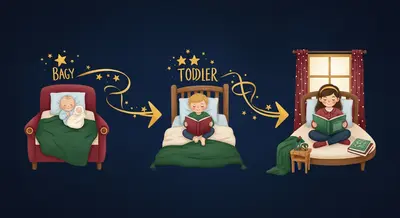
For newborns and very young babies
At this stage, your baby isn't following a plot. They're following you. Choose books you genuinely enjoy reading aloud. Rhyming books with a strong beat work beautifully because the rhythm itself is soothing. High-contrast images catch young eyes, but honestly, your baby would rather look at your face.
Pick something short. A book you can finish in under three minutes is ideal, because some nights "storytime" is going to last approximately one and a half pages before someone needs feeding again, and that's perfectly fine.
For babies 4–12 months
Now you can start introducing books with simple, repetitive text — the kinds of stories where the same phrase appears on every page. Repetition is deeply satisfying for babies' developing brains. It's not boring to them — it's a pattern they're learning to anticipate and delight in.
Sturdy board books that can survive being chewed are practical as much as they are charming.
Beyond the first year
This is when personalization starts to work its particular magic. Children who can respond to their own name, who are beginning to understand cause and effect, often light up when they realize the character in the story shares their name and their world. If you haven't yet discovered personalized stories, this is a lovely moment to explore them.
Don't Worry About Doing It "Right"
New parents often feel a quiet pressure around reading: to do it every night, to read with the right expression, to not skip pages, to choose educational books, to make it meaningful.
Let all of that go.
There is no wrong way to read a bedtime story to your child. If you lose your place, that's fine. If you invent half the words because you're too tired to make out the text in the dim light, your baby doesn't know. If you read in a slightly flat, exhausted monotone, your baby still hears your voice, and your voice is their favourite sound in the entire world.
The only thing that matters is that you show up. The habit of storytime — the ritual, the closeness, the winding-down — is built from consistency, not perfection.
Some nights you'll do the voices. Some nights you'll manage two pages. Some nights you'll fall asleep before your baby does. All of it counts.
Building the Habit
Bedtime routines are powerful for babies and toddlers not because they're rigid, but because they're predictable. Predictability means safety. When a baby knows what comes next — bath, feed, story, sleep — the nervous system begins to settle in anticipation of rest. The story becomes a cue: it's nearly time to sleep now.
That cue becomes more powerful the more you use it. Children who have grown up with a consistent bedtime story routine often find it easier to wind down, because their body has learned to associate storytime with the transition to sleep.
Building the habit practically
- Same time, same place: Even if the time shifts slightly, doing stories in the same spot — a rocking chair, the side of the crib, snuggled in your bed — reinforces the ritual.
- Same order: Stories work best when they slot into a predictable sequence — after the bath, before the final feed, or as the very last thing before lights out. Find your sequence and stick to it.
- Keep it low-key: Bright screens, loud toys, and high-energy play right before stories make it harder for young children to shift down. Dim the lights, lower your voice, and let the story do its work.
- One book or three? There's no rule. Follow your child's lead. Some nights one short book is right. Some nights you'll read the same book four times because they keep saying "again" and you can't quite bring yourself to say no.
Your Voice Is the Magic Ingredient
Here's the thing no book, app, or personalized story platform will ever be able to replace: you.
Your voice, specifically. Not a professional narrator's voice. Not a perfectly modulated, ideally paced reading voice. Your actual voice, with its particular warmth and its tiredness and its little laugh when something strikes you as funny and its tendency to go a bit wobbly on emotional bits.
Children don't fall in love with stories in the abstract. They fall in love with stories through the person telling them. The story becomes associated with safety, closeness, and being loved. That's why adults remember childhood bedtime stories with such tenderness — not just the tale, but the feeling of being read to.
You are the magic. The book is just the vehicle.
So when you're second-guessing your voice, your choices, your consistency — remember that your child isn't evaluating any of it. They're just glad you're there.
One Last Thing
If you're in the thick of early parenthood — tired in a way you didn't know was possible, still figuring out a rhythm, perhaps reading this at 2am while a very small person sleeps on your chest — then you're doing brilliantly.
The fact that you're thinking about bedtime stories, wondering how to do them well, wanting to offer your child that particular kind of magic — that's already everything.
Start where you are. Read what you have. Use the voice you've got. And know that somewhere in the middle of a simple story about a bear, or a moon, or a train that just won't give up, something is being built between you and your little hero that will last a lifetime.
That's worth more than any perfectly executed storytime.
Looking for a story that makes your little one the hero from the very first page? Discover how OnceUponMe creates personalized bedtime stories with your child's name, personality, and the details that make them uniquely them.