7 Science-Backed Benefits of Personalized Stories for Children
From stronger literacy to a bigger sense of self, discover the 7 research-supported benefits of personalized stories for children — told with warmth.
7 min read
7 Science-Backed Benefits of Personalized Stories for Children
Ask any parent what they hope for their child, and somewhere near the top of the list — nestled between good health and good friendships — you'll usually find some version of this: I want them to love reading.
It seems like a simple wish. But it carries so much inside it. A child who loves reading is a child who loves learning, who can inhabit other lives and other worlds, who has a place to go when things feel hard, and who grows up with the extraordinary capacity to understand themselves and others with unusual depth and grace.
The question is: how do you light that fire?
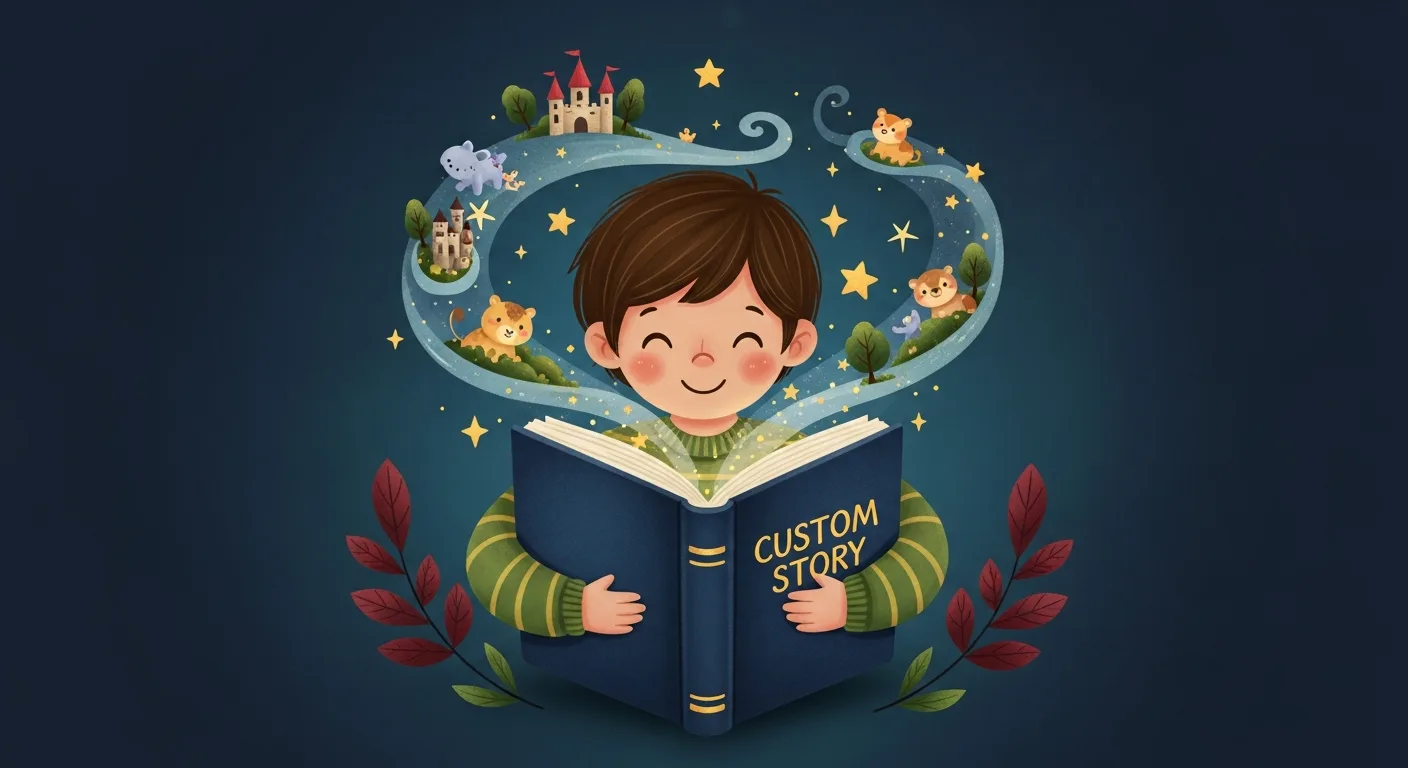
Personalized stories — tales where your child is the hero, where their name and their world are woven into the very fabric of the narrative — have a remarkable track record of doing exactly that. And while the magic of seeing your name on the first page needs no scientific justification, it's reassuring to know that the research agrees with what parents already feel in their bones.
Here are seven genuine, research-supported benefits of personalized stories for children. No jargon, no charts — just the good news, told warmly.
1. They Turn Reluctant Readers Into Willing Ones
This is perhaps the most immediate and visible benefit, and it happens almost every time.
Reading researchers have long studied the concept of motivation to read — the internal drive that makes a child choose a book over the television, or ask for one more page instead of rolling over to sleep. What they've found, consistently, is that children are most motivated to engage with texts that feel personally relevant to them.
A 2019 study from the University of Waterloo found that children who read stories featuring characters with their own names showed significantly higher engagement and recall than those reading the same stories with unfamiliar names. The personal connection created a kind of reading momentum — once children were in, they stayed in.
For children who have never quite clicked with books, a personalized story can be a revelation. When your little hero opens a story and discovers that they — specifically, wonderfully, unmistakably they — are on the adventure, the question of whether reading is "for them" answers itself immediately.
2. They Strengthen Early Literacy Skills
Here's something wonderful that happens when a child is deeply engaged in a story: their brain does a great deal of very useful work almost without noticing.
Children who are captivated by what they're reading (or hearing read aloud) naturally absorb new vocabulary, internalise sentence structures, and develop an intuitive sense of how narrative works. These are foundational literacy skills — the kind that support reading fluency, comprehension, and writing ability for years to come.
Because personalized stories hold children's attention so effectively, they create the conditions for this kind of deep, effortless literacy learning. The child isn't consciously studying language. They're leaning forward to find out what happens next to them, and the language is quietly doing its work.
Research from the National Literacy Trust in the UK has consistently shown a strong link between reading enjoyment and reading attainment. The two are beautifully circular: children who enjoy reading get better at it, and getting better at it makes them enjoy it more. Personalized stories are a wonderful way to step into that circle for the first time.
3. They Build Self-Esteem in a Tangible, Story-Shaped Way
When a child is the hero of a story — when the narrative positions them as brave, curious, kind, or clever — something shifts in how they understand themselves.
This isn't wishful thinking. It's rooted in a well-established principle of developmental psychology called narrative self-understanding: the idea that children construct their sense of who they are partly through the stories told about them and around them. When the stories your child encounters consistently place them at the center of meaningful, positive experiences, those stories become part of the architecture of their self-concept.
A child who has been the hero of a hundred adventures begins to carry something of that heroism with them. Not arrogance — something quieter and more useful than that. A sense of I am someone things happen to. I am someone who can handle what comes.
For a deeper look at how stories shape identity specifically, visit our article on how personalized stories help children build a sense of identity.
4. They Support Healthy Identity Development
Children between the ages of two and eight are in one of the most intense periods of identity formation they will ever experience. They are asking — constantly, in every way they know how — Who am I? Do I matter? Is there a place for me in this world?
Books have always been one of the places children look for answers. The research on representation in children's literature bears this out: children who see characters like themselves in stories show greater confidence, stronger cultural pride, and a more secure sense of belonging. The mirror that a story holds up can be extraordinarily powerful.
Personalized stories offer a particularly direct version of this mirror. When the hero shares your child's name, reflects their personality, and navigates a world that echoes their own, the message is clear and deeply felt: You are the kind of person stories are written about. You belong here.
5. They Expand Emotional Vocabulary and Empathy
Stories have always been humanity's most effective empathy technology. Long before there were books, there were tales told around fires — tales that allowed people to feel what it was like to be someone else, somewhere else, facing something they had never faced themselves.
For children, this empathy-building function of stories is especially important. Emotional literacy — the ability to name, understand, and navigate feelings — is one of the strongest predictors of social success and mental wellbeing in later life. And stories, it turns out, are one of the most reliable ways to develop it.
Personalized stories add a particular layer to this process. When your child is the one navigating a difficult moment in the story — when they are the one who must decide whether to be kind or brave or patient — the emotional resonance is heightened. They're not watching from a distance. They're inside the experience, feeling their way through it with their own named self as the guide.
Studies from the University of Toronto have found that heavy fiction readers score higher on measures of empathy and social understanding — and the mechanism appears to be precisely this: the practice of inhabiting other perspectives from the inside.
6. They Build Vocabulary in the Most Natural Way Possible
Vocabulary acquisition is one of those things that sounds dry in theory and is entirely wonderful in practice. Children learn new words most effectively in context — when they encounter a word they don't know inside a story they're emotionally invested in, their brain works to make sense of it using all the clues available. This is called incidental vocabulary learning, and it's far more durable than any flashcard.
The richer the text, the more opportunity for this kind of learning. And because personalized stories hold children's attention so completely, they create ideal conditions for it. A child who might gloss over an unfamiliar word in a story they're only half-engaged with will pause, wonder, and absorb that same word in a story where they are the one using it.
Parents often notice this effect in the days after reading a new personalized story: a word that appeared in last night's adventure showing up in conversation at breakfast. It's one of those quiet, delightful moments that reminds you just how much is happening behind those curious eyes.
7. They Cultivate a Lifelong Love of Reading
All of the benefits above fold into this one, which is perhaps the most far-reaching of all.
Children who associate reading with pleasure — with the particular thrill of being seen, the excitement of adventure, the comfort of a story that feels like home — grow up to be adults who read. And the benefits of adult reading are almost embarrassingly extensive: higher empathy, lower stress, better cognitive resilience, richer relationships, and a lifelong capacity for imagination that enriches everything else.
The seeds of all of this are planted early. They are planted in the moments when a small child discovers that stories are not something that happen to other people. Stories are something that happen to them.
A personalized story is a remarkable way to plant that seed. It says, unmistakably and with great warmth: This is your story. It has always been yours.
The Benefits Work Together
What makes personalized stories so powerful isn't any single one of these benefits — it's the way they interweave and reinforce each other. A child who feels seen in a story pays more attention. A child who pays more attention learns more words. A child who learns more words becomes a more confident reader. A more confident reader finds more stories to love. And a child who loves stories grows into someone who understands the world — and themselves — with remarkable depth and grace.
It begins with something as simple as hearing their own name called out on the first page of an adventure. It ends, if you let it, with a lifelong love of reading that colours everything it touches.
To understand more about how personalized stories fit alongside the traditional books you already love, visit our guide to personalized stories vs. traditional books. Or if you're new to the world of personalized children's books, start with our complete guide to what personalized kids stories are.
A Story Waiting to Begin
Your little hero is already remarkable — curious and brave and full of the kind of wonder that only exists in childhood for a little while before it quietly changes shape.
A story that knows their name, reflects their spirit, and sends them on an adventure built just for them isn't just a lovely gift. It's an investment in the reader, the thinker, and the whole magnificent person they're becoming.
Whenever you're ready to begin their next great adventure, we're here.