How Personalized Stories Help Children Build a Sense of Identity
Discover how personalized stories child identity develops through the mirror of narrative — and why seeing themselves as the hero changes everything.
7 min read
How Personalized Stories Help Children Build a Sense of Identity
Watch a very young child carefully for a little while, and you'll notice something extraordinary happening. They're not just learning to walk and talk and name the animals in their picture books. They are — with tremendous effort and no instruction whatsoever — figuring out who they are.
This is one of the great projects of childhood: the slow, beautiful, sometimes wobbly construction of a self. And it turns out that stories play a more central role in this process than most of us realise.
Not just any stories. Their stories. The ones where they recognise something of themselves. The ones that hold up a mirror and say: Yes. You. This is the shape of you, and it is good.
The Story We Tell Ourselves About Ourselves
Psychologists have a concept called narrative identity — the idea that human beings don't experience their lives as a series of disconnected events, but as a story. We are, all of us, the protagonist of an ongoing tale we are always, quietly, writing about ourselves.
This story shapes everything: how we respond to challenges, how we relate to other people, whether we believe we are capable of growth and change, whether we feel we belong in the world or are somehow peripheral to it.
Children begin constructing this story very early. From the age of about two, children are already starting to form a coherent narrative about who they are — drawing on what they're told, what they observe, and what they experience. The stories they encounter, and the stories that are told about them, become part of the raw material for this construction.
This is why the books we put in children's hands matter as much as they do. Every story a child reads is, in some small way, an answer to the question they are always asking: Is there a version of me in this world? Do people like me get to be the hero?
The Mirror Effect: Why It Matters to See Yourself in a Story
Researchers who study representation in children's literature sometimes call it "the mirror and the window": books can function as windows that let children see into other worlds and other lives, or as mirrors that reflect their own world and identity back at them.
Both matter. Windows build empathy and expand imagination. But mirrors — books that reflect a child's own identity, their face, their family, their experience of the world — do something different and equally vital. They affirm.
When a child finds themselves in a story, the message received is not merely "this character looks like me" or "this character shares my name." The message, felt rather than consciously processed, is something deeper: Someone thought people like me were worth writing about. My kind of life has stories in it. I exist in narrative, which means I am real and significant in the way that stories are real and significant.
For children who rarely or never see themselves in the books they encounter — whether because of their name, their background, their family structure, or the particular texture of their world — this affirmation can be genuinely transformative.
Personalized stories offer this mirror directly, immediately, and without leaving it to chance.
The Protagonist Effect: What Happens When Your Child Leads the Story
There is a meaningful difference between identifying with a character and being a character. Traditional books offer the first; personalized stories offer the second.
When Your Child Is the One Who Chooses
In a personalized adventure, the brave decision is made by your child. The problem solved, the kindness shown, the moment of courage that changes everything — these belong to them. Not to a character they admire from the page, but to the named, specific, real child sitting in your lap or tucked into their bed.
This matters because children tend to internalise the qualities that stories assign to their protagonist self. A child whose story names them as curious and brave doesn't just passively receive those labels — they begin to understand them as part of who they are. Narrative psychologists call this identity assimilation: the way that stories we identify with become integrated into our self-concept.
Over time, a child who has been the hero of many adventures — who has been curious, brave, kind, and clever across dozens of story-worlds — begins to carry those qualities as their own. Not because they've been told to, but because the story showed them who they already were.
When the World Bends Around Your Child
There's another element of personalized stories that's easy to overlook: the world of the story is built around your child, not the other way around. The adventure arises from their particular qualities. The solution calls on their specific gifts.
This is subtly but significantly different from even the most beloved traditional book, where the world is fixed and the child fits themselves into it as best they can. In a personalized story, the world fits itself around your child. The narrative says, quietly but unmistakably: You are the center. The story organises itself around you, because you are worth organising around.
Identity, Representation, and the Question of Belonging
One of the deepest functions of a story is to answer the question of belonging. Does someone like me belong here, in this world, on this adventure?
For many children, traditional children's literature answers this question warmly and well. But for others, the answer is less clear. A child whose name is unusual or whose family structure is different, a child who looks different from the heroes in most of their books, a child navigating a cultural identity that rarely appears in the stories available to them — for these children, the question of belonging in narrative can feel genuinely uncertain.
Personalized stories sidestep this uncertainty entirely. There is no question of whether your child belongs in the adventure. They are the adventure. Their name is the name the story calls out. Their world is the world the story is set in. Their family, their passions, their particular kind of wonderful — all of it is built into the fabric of the tale.
This is not a small thing. Research on representation in children's media consistently finds that children who see themselves reflected in stories show higher self-worth, stronger cultural confidence, and a greater sense of possibility — a belief that the world of human endeavour has a place in it for them. Personalized stories make that reflection direct and undeniable.
Building Self-Concept Through Repeated Story Experiences
Identity is not built in a single moment. It's built the way a cliff is shaped by water — slowly, through repeated contact, over a long time.
This is worth remembering when thinking about the role of personalized stories in a child's development. A single story where your little hero saves the day is a delight. A whole library of stories — each one returning, from different angles and different adventures, to the message that this particular child is brave, curious, kind, and capable — is something more. It's a slow, steady accumulation of self-knowledge.
The most powerful thing a personalized story can do is not the single thrilling moment when a child hears their name in the first paragraph. It's the long-term work of confirming, again and again, through narrative and adventure and warmth, that this child is the kind of person stories are written about. That their life is interesting. That they matter.
What This Looks Like in Practice
Parents who have read personalized stories with their children over time often notice particular moments that stay with them:
- A child who describes themselves, unprompted, using a quality that featured in their story: "I'm brave, like when I found the dragon."
- A child who approaches a difficult real-world situation with a kind of narrative confidence — as if they've already been through something like this and know how it turns out.
- A child who asks for more stories not because they want to be entertained, but because they want to go back to a world where they are unambiguously the hero.
These moments are not coincidences. They are the identity-building work of stories, visible to the naked eye.
The Mirror and the Map
Here is another way to think about what personalized stories do for a child's developing identity: they function as both mirror and map.
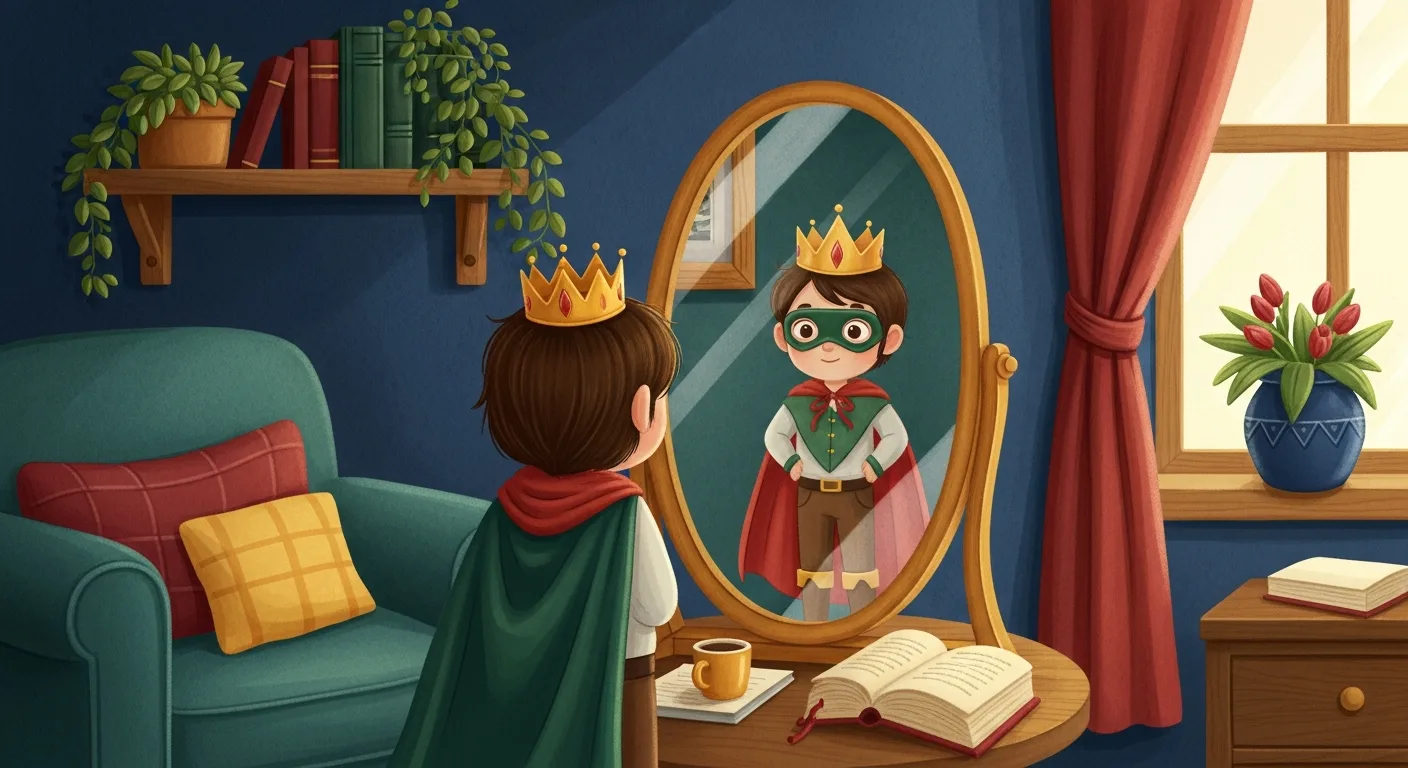
As a mirror, a personalized story reflects your child back to themselves — shows them their own name, their own qualities, their own place in the story of the world. The reflection says: You are real and significant. You are worth a story.
As a map, a personalized story shows your child the territory of their own potential — the adventures they might have, the challenges they might meet and overcome, the kind of person they are becoming. The map says: Here is where you are. Here is the direction the adventure goes. Here is what you are capable of.
Children need both. The mirror gives them a stable foundation — a sense of who they already are. The map gives them a sense of direction — a vision of who they might become. A good personalized story offers both at once.
To understand more about the broader developmental benefits this kind of deep engagement with stories creates, visit our article on the 7 science-backed benefits of personalized stories for children. And if you're new to personalized stories and wondering where to begin, our complete parent's guide is a warm place to start.
The Story They'll Carry Forward
Long after the pages have been turned and the adventure has ended, something stays. Not just the memory of the story, but the feeling the story left behind — the sense of having been seen, of having been at the center of something meaningful, of having been confirmed as someone worthy of adventure.
Children who carry that feeling grow up with a particular kind of quiet confidence. They don't need to be the loudest in the room or the most obvious hero. But they carry with them, deep and steady, the knowledge that they are someone a story was once written about — and that the story was good.
Your little hero is already all of this. Already brave, already curious, already full of the kind of wonder that belongs at the center of any great adventure.
Give Them the Story That Knows Their Name
The most extraordinary gift a story can give a child is not an exciting plot or a surprising ending. It's the simple, radical, quietly world-changing experience of recognition.
I see you. I know your name. I wrote this for you.
Whenever you're ready to give your child that gift, we're here to help you create it.