Storytime Ideas for Rainy Days: Beyond Just Reading a Book
Rainy days are secret story goldmines. Discover fun storytime ideas that go beyond reading — crafts, acting, forts, and more for your little hero.
6 min read
Storytime Ideas for Rainy Days: Beyond Just Reading a Book
The sky has turned that particular shade of grey. There's a drumming on the windows. Your little hero has pressed their nose flat against the glass, sighed deeply, and announced — with the full weight of a tiny soul — that there is absolutely nothing to do.
You know this moment. And honestly? It is one of the best story opportunities of the whole year.
Rainy days have a kind of magic that sunny days simply cannot touch. The world outside goes hushed and soft. The indoors feels cozier, closer, more contained in the most wonderful way. And stories — the reading of them, the acting of them, the building of them from scratch — come alive in a way they just don't on a bright Tuesday afternoon.
Here are some storytime ideas for rainy days that go well beyond pulling a book off the shelf (though that is always a beautiful choice too).
Build a Blanket Fort First, Then Tell the Story
There is something about a blanket fort that makes every story feel more important. The low ceiling. The dim light. The sense that you have stepped into a different world entirely.
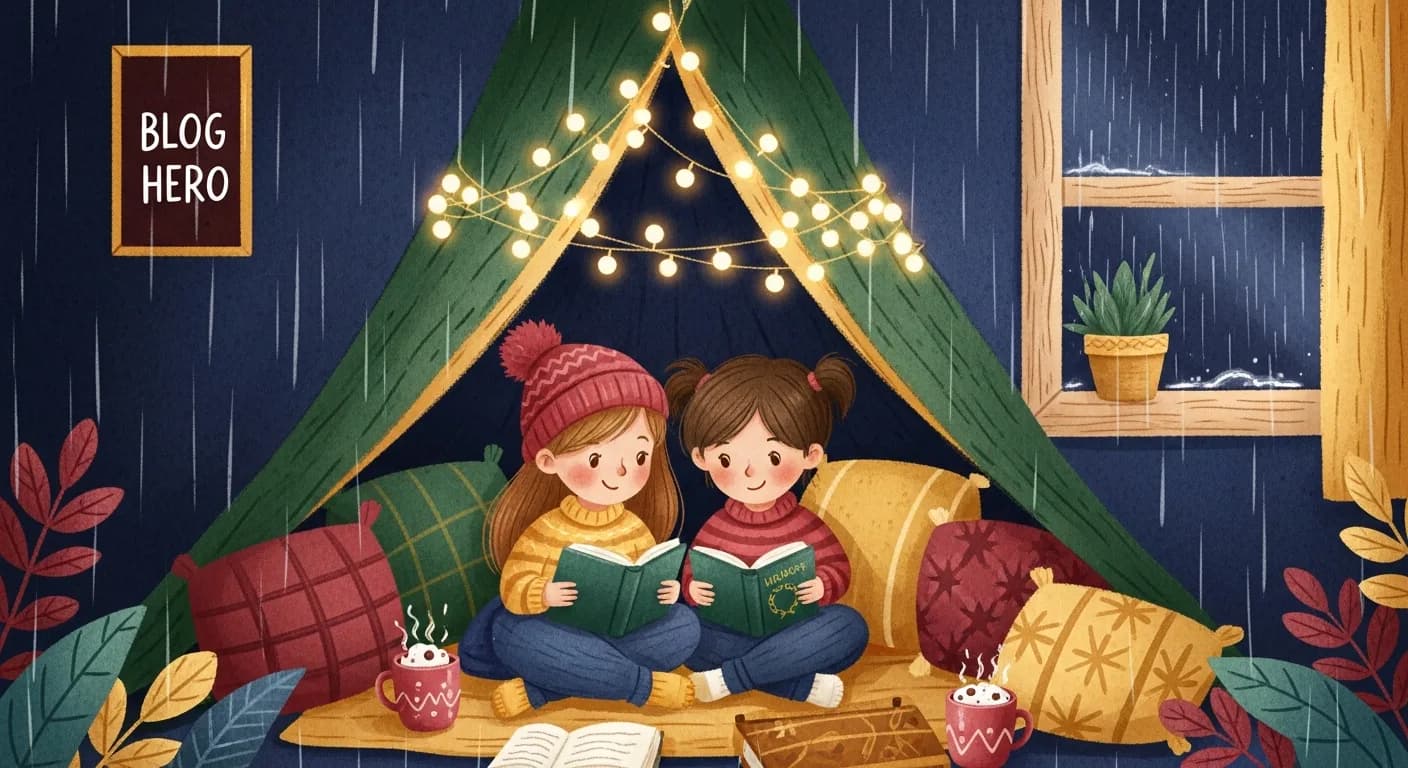
Before you pick up a single book, spend ten minutes building the fort together. Gather every spare blanket, cushion, and pillow in the house. Drape sheets over chairs. Pile up cushions as walls. Let your little hero be the architect — they always have very strong opinions about where the entrance should go.
Then crawl inside with a flashlight (or even a string of fairy lights if you have them) and read. The same story you have read a dozen times will feel entirely different in there. Familiar characters become more vivid. Suspense becomes genuinely suspenseful. The blanket fort is, in its own way, the world's most affordable story studio.
What makes it work
The enclosed space helps children focus. It removes distractions — the toy on the floor, the view from the window, the general chaos of a living room — and creates a small, dedicated world just for story time. Children who typically wriggle and fidget often settle more naturally in a cosy, contained space.
Act Out the Story as You Read It
Pick a favourite story and turn it into a performance. You do not need costumes (though a tea-towel-as-cape never goes amiss). You do not need a script. You just need the book and a willingness to be a little bit ridiculous.
Read a sentence, then act it out together. When the bear lumbers through the forest, lumber through the hallway. When the princess speaks in a grand voice, use your grandest voice. When the hero leaps over the stream, leap over the cushion you have placed helpfully on the floor.
This kind of embodied storytelling is brilliant for younger children especially. It connects language to movement and feeling in ways that help them understand — and remember — the story at a much deeper level. And you will find that the parts that usually drag ("this bit is boring, Mum") become the most fun to interpret physically.
A rainy day version: shadow puppets
Close the curtains, get the flashlight back out, and hold up your hands against the wall. Rabbits, wolves, and dragons are all achievable with a bit of practice (and the dragon just requires all your fingers spread wide and a willingness to move them menacingly). Create the characters together, then take it in turns to tell the story through them.
Create Your Own Story from Scratch
One of the very best storytime ideas for rainy days is to skip the book entirely and make something new.
Start with a simple prompt. "Tell me about a little kid who finds a door in a tree." Or "What happens when it rains so hard that all the puddles join together into one giant lake?" Let your little hero take the lead, and resist the urge to shape their story into something sensible. The best children's stories are not sensible. They involve dinosaurs appearing in kitchens. They involve the moon deciding to take a holiday. They involve, very often, a character called something like "Sir Bumblebee Crumble."
You can take turns — you add a sentence, they add a sentence. Or you can be the scribe, writing down exactly what they say (children are enormously proud when they hear their own words read back to them as a "real" story). Or you can draw it together: one panel at a time, creating a story in pictures.
The rainy day story jar
Keep a jar in the house filled with little folded papers. On each paper, write a single story ingredient: a character, a setting, a problem, a magical object. On rainy days, pull out three or four and see what story emerges when you combine them. "A nervous cloud, a lost golden key, and a talking library" will keep a creative child busy for a surprisingly long time.
Story-Inspired Crafts
After you have read a story together, ask: "What would you most like to make from that story?"
The answers will surprise you. It might be a crown for the princess. It might be a tiny clay dragon egg. It might be a "wanted" poster for the story's villain, complete with a crayon portrait. Story-inspired crafts help children hold onto a story, turning it from something that happened to them into something they have touched and made.
You do not need craft supplies beyond what most households already have. Paper, scissors, tape, and crayons can produce: a book cover for the story, a map of the story's world, a house for the main character made from folded paper, or a paper-puppet cast of characters.
This works especially well for stories your little hero has heard several times. They know the world well enough to want to inhabit it.
The Audio Story Dance Party
This one requires very little preparation and produces a remarkable amount of joy.
Queue up an audiobook or a podcast story for children. Then declare — with absolute conviction — that in this house, you do not simply listen to stories. You dance to them.
Move however the story moves. When something exciting happens, spin. When it goes quiet and mysterious, tiptoe. When a character runs, run. When there is a feast, mime eating with tremendous enthusiasm.
It sounds chaotic because it is chaotic. But the movement helps younger children stay engaged with longer audio stories, and the shared silliness of it creates the kind of memory that sticks. Years from now, your little hero may not remember the exact plot of whatever they were listening to — but they will remember dancing to it with you in the kitchen on a rainy afternoon.
Treat the Rain as a Story of Its Own
Here is a slightly different idea: instead of retreating from the rain, bring it into your story time.
Stand at the window together and watch. Ask questions. "Where do you think all that water comes from?" "If a very small creature lived in that puddle, what kind of creature would it be?" "What does a raindrop see on the way down?"
You are doing something important here. You are teaching your little hero to look at the ordinary world and find story in it. That is the same skill that every author, every storyteller, every dreamer has ever had. It is not a skill that gets taught in a classroom. It is a skill that gets grown in moments exactly like this one — standing at a window, watching rain, with someone who takes your imagination seriously.
Follow the questions wherever they lead. Draw the creature who lives in the puddle. Write its name down. Give it a problem to solve. By the time the sun comes back out, you will have started a whole new story together.
Bring Your Story to Life with Something Personal
There is a particular delight that arrives when a child hears their own name in a story — when the hero of the adventure is not just any brave child but them, specifically, with their quirks and their favourite things and the colour of their wellies and the name of their best friend. A personalized story can turn even the most ordinary rainy afternoon into something that feels genuinely magical.
At OnceUponMe, every story is built around your little hero — their name, their personality, the things that matter most to them. Pop one on during the blanket fort session, or save it for the quiet bit after the craft supplies are packed away. You might be surprised how hard it is to get them to leave the fort once the story has started.
One Last Thing About Rainy Days
The rain will stop. It always does. And your little hero will charge back outside and forget, for a while, the extraordinary afternoon you spent together in a blanket fort with a flashlight and a story.
But something will remain. Not the plot, maybe. Not the specific words. But the feeling — that stories are where you go when the weather turns, that words and imagination are the cosiest shelter there is. That feeling tends to last a lifetime.
So next time the rain arrives: resist the screen, find the blankets, and start a story. The world outside can wait.
Looking for more ways to make reading magical? Explore our guide to making bedtime stories interactive or discover why kids love seeing their name in stories.