Choosing Age-Appropriate Stories: A Quick Reference for Parents
Not sure which stories suit your child's age? This friendly quick-reference guide covers ages 0–8+ so you can always find the perfect story match.
7 min read
Choosing Age-Appropriate Stories: A Quick Reference for Parents
Every parent has been there. You are standing in the library or the bookshop or hovering over an online page at 11pm, trying to decide whether a particular story is the right fit for your child. The back cover says "ages 3–5." Your child is four. But are they a young four or an old four? Does it matter? What are you even looking for?
The good news is that choosing age-appropriate stories is much less complicated than it can feel in the moment. Children are remarkably capable of telling you when a story is wrong for them — they wriggle, they tune out, they demand a different one with impressive directness. But having a rough sense of what tends to land at different stages means you can walk into story time with confidence, not guesswork.
This guide is a practical, pressure-free reference. Think of it as a map, not a rulebook. Every child is wonderfully different, and the ages below are starting points, not judgements.
Ages 0–2: Simple, Sensory, and Sung
What's happening developmentally
Babies and very young toddlers are not yet following plots. They are experiencing the world through sound, rhythm, texture, and the faces of the people they love. Story time at this age is less about narrative and more about connection and sensory richness.
What to look for in stories
- Very simple language — short sentences, single words, clear repetition
- Bold, high-contrast illustrations — babies respond strongly to simple shapes and strong colour contrasts
- Rhythmic, musical text — the sound of language matters more than the meaning at this age; rhyme and rhythm feel almost physical to young babies
- Sensory elements — touch-and-feel books, board books with different textures, books with sounds
- Familiar objects and faces — stories that name and picture things from a baby's daily world (cups, beds, dogs, hands) help them make connections between words and reality
Story types that work
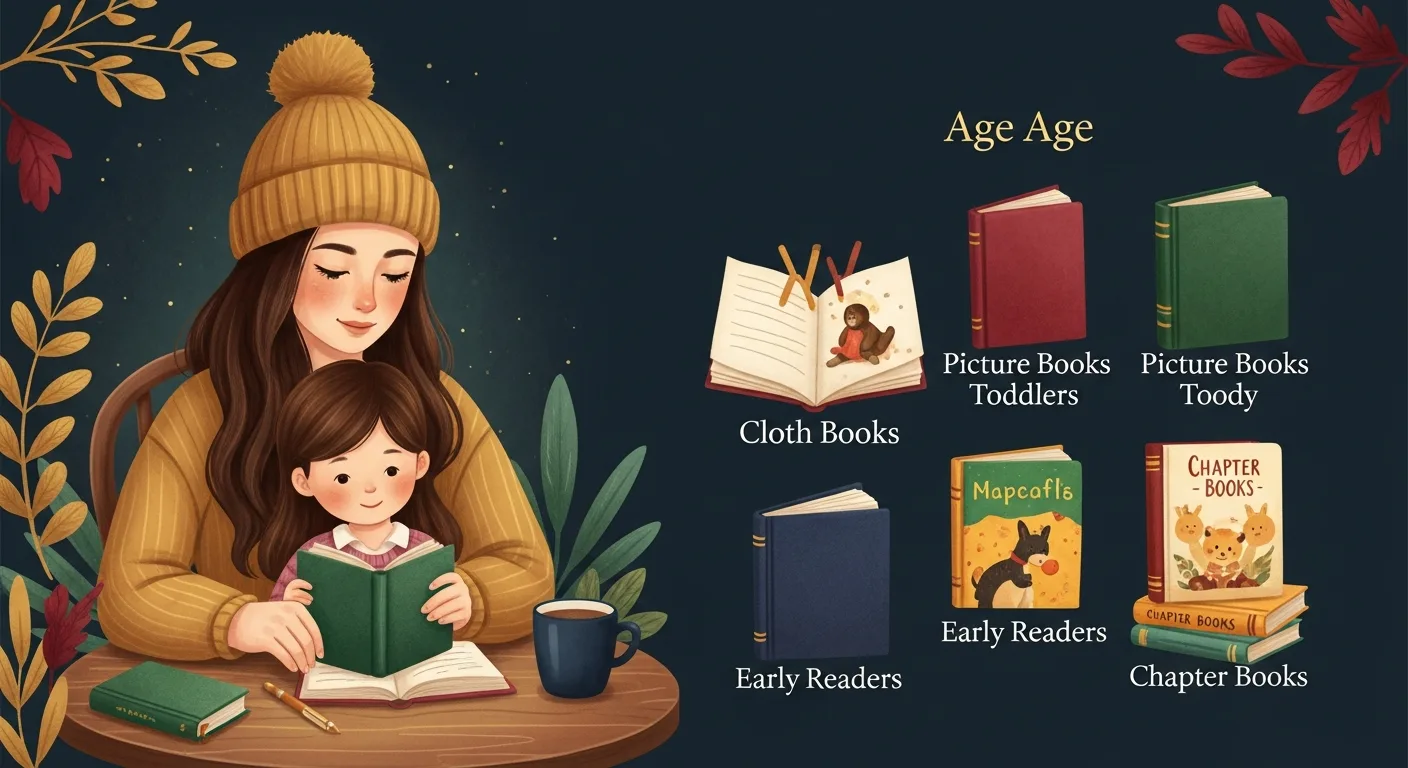
Board books, nursery rhymes, simple counting and naming books, lullaby-style picture books. At this age, "reading" a book might look more like talking about the pictures than following a story — and that is completely right.
Quick tip
The same book, read many times, is better than many books read once. Repetition builds familiarity, and familiarity is profoundly comforting at this age.
Ages 2–3: Repetition, Silliness, and Small Stakes Adventure
What's happening developmentally
Toddlers are language-hungry. Vocabulary is exploding, the sense of self is emerging ("mine" is their favourite word for a reason), and they are discovering that the world has rules — which they are simultaneously delighted and outraged by. They love to laugh, they love to be surprised, and they love to hear the same story again immediately after you have finished it.
What to look for in stories
- Repetitive structure and refrains — stories with a repeating phrase or pattern (the same door knocked on, the same question asked) allow toddlers to predict and participate
- Humour — potty humour, slapstick, the unexpected — toddlers find this hilarious and the laughter is genuinely good for them
- Simple emotional themes — stories about wanting something, feeling left out, being scared of the dark, getting cross — the big feelings of toddlerhood handled with lightness
- Very clear story arcs — beginning, small problem, resolution; nothing too complex
- Loveable, slightly mischievous characters — toddlers identify strongly with characters who do things they are not supposed to do and survive it
Quick tip
Do not worry if a story gets interrupted by questions, digressions, or requests to "go back and look at the dog again." This is engagement, not distraction. Follow your child's attention.
Ages 3–5: Adventure, Big Feelings, and the World Getting Bigger
What's happening developmentally
This is the age of imagination catching fire. Children this age can hold a story in their minds, feel genuine suspense, and care deeply about what happens to characters. They are also navigating a much wider social world — nursery, playgroups, the enormous puzzle of other children — and stories that reflect this world are deeply engaging.
What to look for in stories
- Adventure and quest structures — the character sets out, faces challenges, finds their way. Even a small adventure (a lost toy, a new friend) carries the full emotional weight of an epic journey at this age
- Emotional complexity — stories that show characters feeling more than one thing at once (excited and scared; happy and missing someone) build emotional intelligence beautifully
- Friendship and social dynamics — how do you make a friend? What do you do when someone is unkind? These themes resonate powerfully
- Fantasy and magic — dragons, fairies, talking animals, wishes that come true — imagination is at full throttle and stories should match it
- Slightly longer narratives — picture books with more words, early chapter books read aloud, stories that take more than one sitting
Quick tip
Ask questions during and after: "What do you think will happen next?" "How do you think the character felt there?" These questions deepen engagement and build comprehension — but keep them light, conversational, not like a test.
Ages 5–7: Longer Narratives, Growing Complexity, and Beginning to Read
What's happening developmentally
Many children in this age range are beginning to decode written language themselves, which is an extraordinary cognitive leap. They are also navigating school life in earnest — rules, fairness, friendship, identity — and they have developed enough empathy to genuinely care about characters who are different from themselves.
What to look for in stories
- Longer, more complex plots — multiple chapters, subplots, characters with real history and growth
- Moral and ethical questions — not heavy-handed morals, but stories that raise genuine questions: Was that the right thing to do? What would you have done?
- Beginning readers — early chapter books and illustrated chapter books allow children to start reading independently while still enjoying read-alouds for complexity above their reading level
- Diverse characters and worlds — children this age are increasingly curious about people and lives different from their own; stories that reflect this curiosity expand empathy meaningfully
- Humour that respects their intelligence — wordplay, irony, jokes that require knowing something — children this age love stories that credit them with being clever
Quick tip
This is a great age to read aloud books that are slightly above your child's independent reading level. They can follow a more complex story than they can currently decode themselves, and hearing you read builds vocabulary and love of language simultaneously.
Ages 7–8 and Beyond: Complex Themes and the Beginning of a Reading Life
What's happening developmentally
Children in this range are becoming real readers — not just decoders but people who choose books, have preferences, revisit favourites, and talk about characters as if they know them. They are also encountering the full emotional range of life: friendships that break, unfairness that is real and not easily resolved, questions about the world that do not have tidy answers.
What to look for in stories
- Complex, flawed characters — characters who make mistakes, hold contradictions, grow in ways that are not always comfortable
- Real stakes and genuine tension — children this age can handle stories that do not promise everything will be fine; they respect stories that take them seriously
- Series and longer books — the joy of living in a fictional world across multiple volumes is one of the great pleasures of childhood reading; finding the right series can make a lifelong reader
- Non-fiction narratives — biographies, true stories, narrative non-fiction — many children this age develop passionate interests and want stories from the real world too
- Stories that ask big questions — about justice, about difference, about what matters and why
Quick tip
Do not worry if your child reads "below their level" for pleasure. A seven-year-old reading picture books is not regressing — they are enjoying. Follow the joy, not the reading level.
A Note on Reading Aloud to All Ages
Here is something worth saying clearly: you do not have to stop reading aloud when your child can read independently. Reading together — a parent's voice, a shared story, the ritual of stopping for questions or laughter or the occasional dramatic character voice — is valuable at every age. Many families read aloud together well into secondary school, and every one of them will tell you it is worth it.
The relationship you build around stories is not a phase. It is a foundation.
Personalized Stories Work Beautifully at Every Stage
From the very simplest "here is a baby who looks just like you" board book style to a longer adventure starring an eight-year-old who loves dinosaurs and hates Brussels sprouts — personalized stories meet children exactly where they are.
At OnceUponMe, stories are crafted around your little hero's age, interests, and the things that make them specifically, wonderfully themselves. Whatever stage you are at, there is a story waiting that fits just right.
Want to explore further? Read about why kids love seeing their name in stories or discover personalized stories for toddlers.