Personalized Stories for Toddlers: What Makes Them Special
Personalized stories for toddlers do more than delight — they build identity, language, and love of reading. Discover what makes them so powerful at ages 1-3.
6 min read
Personalized Stories for Toddlers: What Makes Them Special
Ask the parent of a toddler to name the most astonishing things their child has done lately, and you'll get a list that reads like a catalog of small miracles.
They learned a new word — and used it correctly. They pointed to a picture and said the name of the thing. They laughed at the funny part of a book before you got there. They sat still, completely transfixed, while a story unfolded, and then looked up at you when it was over with an expression that said, quite clearly: again.
Toddlerhood — those wildly formative months between one and three — is one of the most extraordinary periods in human development. The brain is building itself at a pace it will never match again. Language is arriving by the handful. Identity is beginning, quietly, to take shape. And stories? Stories are right there at the center of all of it.
A personalized story for a toddler is not just a sweet keepsake. It is a surprisingly powerful tool — for language, for self-concept, for the kind of early literacy that sets the stage for everything that follows.
What Happens in the Toddler Brain During Storytime
To understand why personalized stories work so well for toddlers, it helps to understand what's happening in that little brain during a shared reading session.
At around 12-18 months, toddlers begin to understand that the words they hear correspond to things in the real world. When they hear "dog" in a story and see the picture of a dog, something clicks — and that click strengthens the neural pathway between word and concept. Repeated exposure to the same words in the same contexts is not boring. It is building.
By age two, most toddlers are in the midst of a vocabulary explosion. They're acquiring words at a rate that seems almost impossible — and the ones that stick fastest are the ones tied to things they already know and care about. Their own name. Their family members. Their beloved objects.
This is exactly why personalized stories are so potent for this age group. A story built around a toddler's own name, their favorite stuffed animal, their little brother, their cat called Marmalade — every element is already in the "known and cared about" category. The brain lights up in a different way. The learning is anchored in love.
The Name Moment: Why It Matters More Than It Seems
Every parent who has read a personalized story to their toddler for the first time reports a version of the same experience.
The child is sitting in their lap, as they always are at storytime, expecting something lovely but familiar. Then the story begins — and their own name appears in the very first sentence. Not the name of some character they're watching from a distance. Their name. In the story. Right now.
What happens next varies. Some toddlers laugh. Some go wide-eyed and silent. Some point at the page and look at their parent as if to check whether this is really happening. Some simply say their own name back, quietly, as if confirming something important.
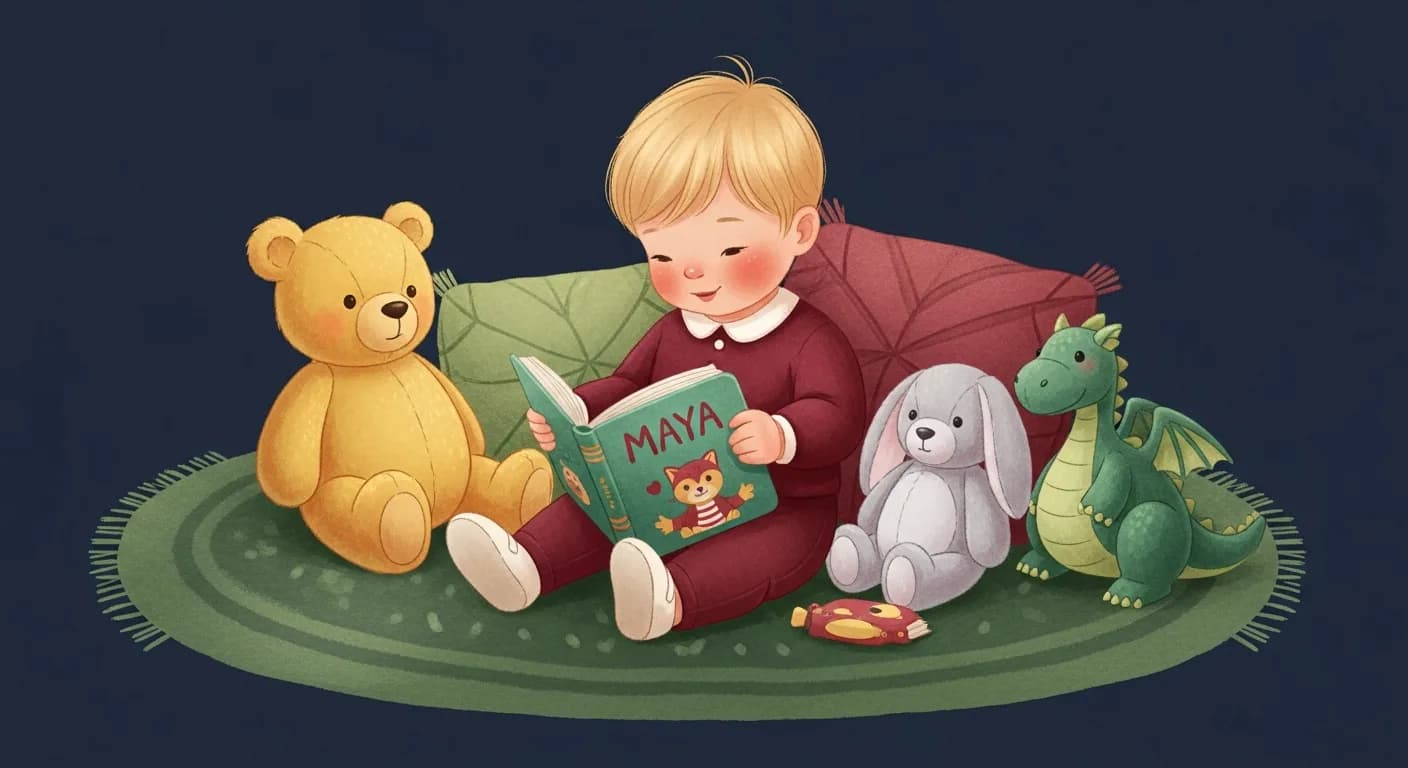
What's happening is real developmental magic. Hearing their own name in a story doesn't just delight a toddler — it activates something in how they relate to the narrative. They are not watching the story. They are the story. And a child who is the story is a child who is learning from it in the deepest possible way.
Self-Recognition and Early Identity
Between one and three, children are in the process of developing something psychologists call the self-concept — a growing understanding of themselves as distinct individuals with their own characteristics, preferences, and experiences.
Stories that center a toddler by name contribute to this process. This story is about me. Which means: There is a me for stories to be about. It seems simple, but the implications for early identity formation are significant. A child who regularly encounters themselves as a character worthy of stories grows up with a different relationship to their own importance in the world.
What Makes a Toddler Story Different (and Right)
Not every story is a toddler story — and a story designed for a preschooler or early reader, however wonderful, will likely lose a one- or two-year-old halfway through. The craft matters enormously.
Personalized stories for toddlers at OnceUponMe are specifically shaped around what we know about how very young children process language and narrative. Here's what that looks like in practice:
Short, Complete, Satisfying
Toddlers have limited working memory and short attention spans — not because something is wrong with them, but because those capacities are still being built. A story that runs too long loses them before the ending. Toddler stories are designed to be complete in themselves within a few minutes of reading: a beginning that establishes warmth and safety, a small adventure or discovery, and a gentle resolution that lands them back somewhere familiar and loved.
Rhythm and Repetition
Repetition is not a failure of creativity in a toddler book — it is the engine of learning. When the same phrase recurs with small variations ("And then your little hero tried again, and again, and again..."), toddlers do something remarkable: they anticipate. They begin to fill in the words before you say them. This is one of the earliest and most important pre-literacy skills there is — the understanding that language has patterns, and that those patterns can be known.
Rhythm serves a similar purpose. Sentences that have a natural beat feel musical to young ears, and music is one of the oldest memory tools humans have. A story that sounds good is a story that gets remembered and requested again.
Simple Language, Deep Warmth
Toddler-appropriate vocabulary doesn't mean dumbed-down storytelling. It means choosing words a toddler either knows or can understand from context — and surrounding those words with a warmth and care that communicates love even before the specific meaning is fully landed. Toddlers are exquisitely sensitive to emotional tone. They know when something is meant for them.
The Benefits Beyond Bedtime
Personalized stories for toddlers do their work in the moment — the giggles, the wide eyes, the pointing — but the benefits extend well past the reading session.
Language Development
Every story session is a vocabulary session. Toddlers who are read to regularly develop larger vocabularies than those who aren't, and they also develop a more nuanced understanding of how language works — how sentences are built, how stories are structured, how words carry feeling. A personalized story adds extra fuel to this process by grounding new vocabulary in a context the child finds deeply engaging.
Emotional Literacy
Even simple toddler stories carry emotional content: a small hero who feels nervous, then curious, then proud. A moment of frustration that resolves into triumph. A warm reunion at the end of an adventure. These emotional beats give toddlers a language for their own inner experiences — a framework for recognizing and naming what they feel. This is the earliest foundation of emotional intelligence.
A Love of Reading
Perhaps most importantly, personalized stories help build the association that will shape a child's entire relationship with books: stories are for me. Reading is not an obligation or a performance — it is a place where something wonderful and personal happens. A child who carries that feeling into school carries something genuinely valuable.
For more on what comes next developmentally — and how stories evolve to serve preschoolers — take a look at our article on personalized stories for preschoolers.
Reading Tips for Toddler Storytime
A few things that make personalized toddler stories land even better:
Slow down at the name. When your child's name appears, give it a beat of emphasis. Watch their face. This is the moment.
Use different voices. Toddlers are learning to read emotional cues from voice as much as from words. Leaning into the wonder-voice, the silly-voice, the hushed-secret-voice teaches them that language is expressive and alive.
Let them lead. If they want to go back to a page, go back. If they want to point at the picture for a full minute before you continue, let them. The "reading" that happens in the silence between words is real.
Read it again. And again. And probably again after that. Repetition is not tedium for a toddler — it's how they deepen their relationship with a story until they genuinely know it. A story they know is a story they love.
A Story That Belongs to Them
There is something gently revolutionary about handing a toddler a story that has their name in it — something that says, in the language of narrative, you exist and you matter and there are adventures waiting for you.
They may not be able to articulate what that feels like. But some part of them will carry it, quietly, into every story they ever encounter after this one.
If you're ready to create your toddler's first personalized adventure, you can find everything you need in our step-by-step guide to creating a story on OnceUponMe. It's simpler than you might think — and the moment it creates is anything but.