Bedtime Stories for Siblings: Making Storytime Work for Two (or More)
Navigating bedtime stories with siblings of different ages? Here's how to make storytime feel fair, fun, and magical for every child in the room.
7 min read
Bedtime Stories for Siblings: Making Storytime Work for Two (or More)
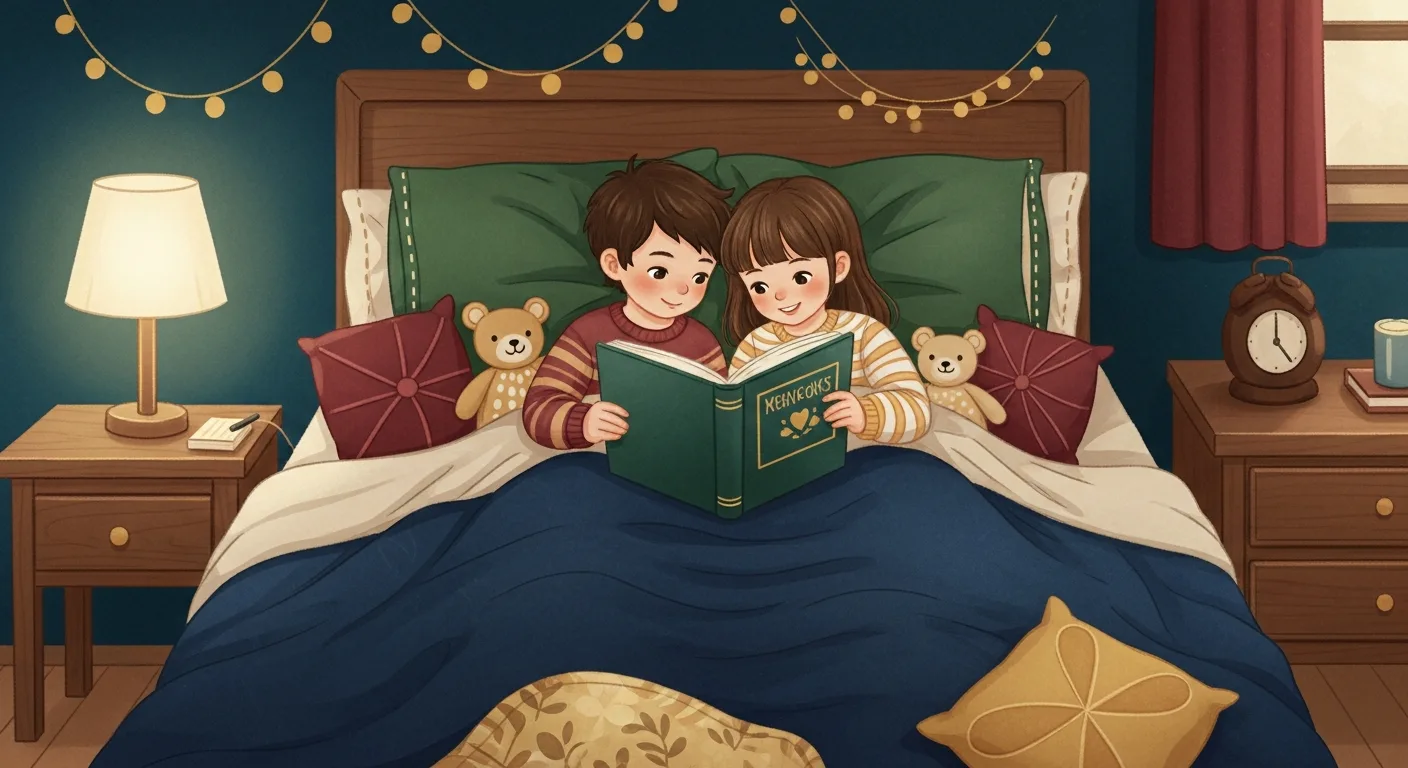
Bedtime stories with one child can feel like a small, sacred ritual — just the two of you, tucked into the lamplight, the day dissolving into the world of a story.
Bedtime stories with two children can feel like trying to run a small, underfunded theatre production in which both actors have wildly different artistic visions and at least one of them is overtired.
If you've ever tried to choose a story that genuinely works for a four-year-old and a seven-year-old at the same time, or found yourself reading increasingly quickly because the baby is nodding off while your five-year-old is still demanding three more chapters, you'll know: sibling storytime is its own particular adventure.
But it can also be one of the richest parts of your family's rhythm — a nightly gathering that each of your children will carry with them long into adulthood. Here's how to make it work.
The Real Challenge: Different Ages, Different Needs
The core tension in sibling storytime is almost always about age gaps. A story pitched at your three-year-old will bore your six-year-old. A chapter book that captivates your eight-year-old will lose your four-year-old entirely. Trying to find the middle ground can feel like looking for something that doesn't exist.
And here's the honest truth: sometimes it doesn't. Sometimes the right answer is separate storytime for children of very different ages. But before you get there, it's worth understanding what's actually going on — because the solution isn't always about finding the perfect shared book.
What each child actually needs from bedtime stories is slightly different:
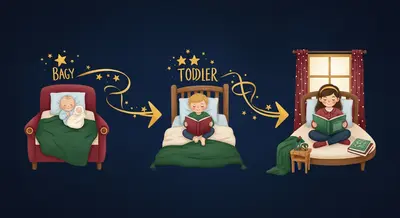
- Toddlers and young children (1–3) need simple language, repetition, pictures, and the warm presence of a caregiver. They're not really following a plot. They're experiencing a ritual.
- Preschoolers (3–5) are beginning to follow stories with clear characters and simple cause-and-effect. They love funny moments, relatable emotions, and anything that confirms they are important.
- Early school age (5–8) can follow longer narratives, enjoy suspense, appreciate humour, and are ready for chapters. They want to be taken seriously as readers.
- Older children (8+) may be reading independently and have strong personal tastes. For them, shared storytime is often more about connection than content.
The gap between a toddler and a school-age child is enormous. But a three- and a five-year-old? A six- and an eight-year-old? These are manageable — especially if you reframe what you're trying to do.
Reframe the Goal: Connection Over Comprehension
The mistake many parents make is trying to find a story that equally engages all their children, at the same level, at the same time. This is a noble but often impossible goal.
A more achievable goal: find a story that creates a shared experience — one where each child is present and engaged, even if they're engaging with different layers of the same story.
Good picture books do this naturally. A beautifully illustrated story about a child who is afraid of the dark works for a three-year-old who is just learning that feeling, a five-year-old who still has it, and an eight-year-old who has grown past it but can remember. Each child is in a different relationship with the story — and that's actually interesting, not a problem to solve.
When you choose shared stories, look for:
- Rich illustration that younger children can explore while older children follow the text
- Layered meaning — books that are funny on the surface and meaningful underneath
- Strong characters that children of different ages can root for in different ways
- Emotional universality — themes like belonging, courage, kindness, and family that resonate across ages
Taking Turns Choosing
One of the simplest and most effective things you can do for sibling storytime is give each child genuine ownership of the story on alternate nights.
It sounds obvious. It is, in fact, profound.
When it's their turn to choose, children are instantly more invested — not just in their own choice, but in the whole ritual. They've had agency. They feel respected. And the nights when it's not their turn become slightly more bearable, because they know their turn is coming.
Making it fair
- Keep a simple rotation that even young children can follow. Monday is Mia's night, Tuesday is Theo's night.
- Let even very young children "choose" — give them two options and let them point to one.
- When it's one child's choice, take a moment to honour it: "Tonight Mia chose this one. I love that she picked it." Small acts of acknowledgement matter enormously.
- If the older child chooses something too complex for the younger, read it but simplify as you go. If the younger child chooses something the older has outgrown, let them be the "expert" — ask them questions, let them predict what happens next.
Stories That Actually Span Age Gaps
While there's no single golden list, certain types of stories tend to work well across a range of ages:
Classic fairy tales and folk tales
There's a reason these have survived for centuries. Stories like The Three Billy Goats Gruff, Cinderella, Anansi the Spider, or The Elves and the Shoemaker work at multiple levels — simple enough for young children to follow, rich enough for older children to find meaning. And the shared cultural knowledge that builds around these stories is its own kind of gift.
Adventure stories with a young protagonist
Books where the main character is a child navigating a large problem — a quest, a mystery, a new world — tend to engage a wide age range. The younger child follows the adventure; the older child identifies with the hero.
Funny stories
Humour is one of the great age-gap bridges. A genuinely funny book creates the same giggle in a four-year-old and a nine-year-old, even if they're laughing at different things. Shared laughter during storytime is one of the best things a family can have.
Personalized stories
This is where it gets interesting. A personalized story that features both of your children as characters — your little hero and their sibling, on an adventure together — solves the engagement problem in a completely different way. There's no age gap when you're both in the story. There's no question of whether it's pitched at the right level. It's pitched at you, specifically, by name.
We've found that siblings who appear together in a story often relate to each other with particular warmth during and after the read — the story becomes a shared mythology, a reference point. "Remember when we went on that adventure together?" can refer to a real memory or a story one, and the warmth is the same.
Personalized Stories for Each Child Individually
For children with a significant age gap — say, a two-year-old and a seven-year-old — the most loving solution is sometimes to give each child their own storytime, however briefly.
This doesn't need to be elaborate. Ten minutes with the younger child while the older reads independently, followed by ten minutes with the older child — a chapter of something they've chosen. The younger child is already asleep. The older child has your full attention and a story suited to them.
What this gives each child is something irreplaceable: the feeling that storytime is theirs, not just a shared resource they have to compete for. That their story matters. That you're there for them.
Personalized stories work particularly well in this context. When a child has a story that was made specifically for them — with their name, their interests, their particular world — the bedtime ritual takes on a different quality. It's not just a story. It's their story. And that matters.
Practical Strategies for the Whole Family
Here's a summary of what tends to work for families navigating sibling storytime:
For small age gaps (1–2 years): Shared storytime is almost always possible. Choose books with rich pictures and accessible themes. Let each child engage at their own level. Alternate who chooses.
For medium age gaps (3–4 years): Try shared storytime first, with the older child as a helper — they point out things the younger one missed, predict what happens next, explain the story. This is engaging for both. When it doesn't work, don't force it.
For large age gaps (5+ years): Prioritize individual storytime, especially for the younger child, who needs the ritual most. Create a brief but meaningful shared moment — a poem, a short picture book, a funny chapter read aloud together — and then split. Let the older child have something that's genuinely theirs.
For mornings when the previous night's story is still alive: Some of the best sibling connection happens not during the story but the morning after — when they're comparing what they remember, acting out the characters, arguing about what should happen next. That's the story working. Don't rush past it.
The Gift of Shared Stories
Here's what you're building, night by night, story by story: a shared imaginative world that belongs to your family.
The books you've read together, the characters you've argued about, the nights when everyone was so tired that the dragon somehow ended up eating the castle and going home to bed (because that felt right) — these become part of your family's mythology. Your children will remember them. They'll reference them. They'll one day read them to their own children.
Sibling storytime, even on the nights when it's chaotic and someone is crying and someone else is complaining the story is boring, is worth every moment of its beautiful, noisy imperfection.
Your little heroes are in there together. Let them adventure together too.
Want a story where both of your children are the heroes? At OnceUponMe, we can weave your children's names and personalities into a single story — an adventure made for your family, told just for them.