Bedtime Stories for Toddlers: Choosing the Right Length and Theme
Everything parents need to know about picking bedtime stories for toddlers — the right length, the best calming themes, and why repetition is actually a good thing.
6 min read
Bedtime Stories for Toddlers: Choosing the Right Length and Theme
Ask any parent of a toddler about bedtime and you will get a very specific look. It is the look of someone who has sung the same song forty-seven times, has negotiated the temperature of water in a sippy cup with the gravity of a peace summit, and who knows — deeply, personally knows — that the difference between a smooth bedtime and a forty-five-minute standoff can hinge on the tiniest of details.
Including the story.
Bedtime stories for toddlers are not simply books read before bed. They are part of the intricate machinery of winding a small, brilliant, relentlessly energetic person down into sleep. And when you choose well — the right length, the right theme, the right gentle rhythm — that machinery hums beautifully.
Here is everything worth knowing about making it work.
Understanding the Toddler Attention Span (and Why It Is Not What You Think)
The conventional wisdom about toddler attention spans tends to underestimate them in one direction and overestimate them in another.
Toddlers — roughly ages one through three — can focus on something they find genuinely engaging for longer than many people expect. Watch a two-year-old with a set of stacking cups or a picture book they love, and you will see sustained, focused attention that could put some adults to shame. The attention span is not short; it is selective.
What toddlers struggle with is passive, extended engagement with something that is not pulling them in. A long, complex story with too many characters, too many plot turns, and not enough sensory anchoring will lose them — not because their brains cannot handle it, but because the story is not offering enough hooks to hold onto.
The implication for bedtime story choices is clear: length matters less than engagement. A beautifully crafted, richly sensory five-minute story is far more effective than a twenty-minute slog through something that fails to hold the imagination. But a gently unfolding ten-minute story with a cozy, immersive world? That can work wonderfully, if the thread is warm enough to follow.
Ideal Story Length for Toddlers at Bedtime
As a practical starting point, bedtime stories for toddlers tend to work best in the range of five to twelve minutes of read-aloud time. That translates roughly to picture books with 500–900 words, or audio stories in the same range.
But there are some useful nuances here:
Younger Toddlers (12–24 months)
At this age, the story is almost secondary to the ritual. What matters most is the warmth of the voice, the closeness of the body, and the gentle rhythm of language. Simple stories with very few characters, clear cause-and-effect, and lots of sensory language ("the soft, warm hay," "the little bird tucked its head under its wing") work beautifully. Five minutes is plenty. Even three minutes, done well, is enough.
Older Toddlers (2–3 years)
Language comprehension has expanded considerably, and toddlers at this age are developing a genuine love of narrative. They want to know what happens next. They will ask questions. They will correct you if you try to skip a page. Stories of eight to twelve minutes feel satisfying rather than rushed — enough arc to hold their attention, not so much that their minds start wandering back to the very important topic of whether they really need to sleep.
The "One More" Factor
It is worth acknowledging: toddlers will often ask for one more story. This is not just stalling (though sometimes it is). It is also genuine delight. The most sustainable approach is to build "one more" into the ritual deliberately — a short first story, then a shorter second one that signals the end is near. The predictability helps.
Calming vs. Stimulating Themes: How to Tell the Difference
This is where a lot of well-meaning bedtime story choices go sideways. A book can be wonderful — funny, clever, beautifully illustrated — and still be entirely wrong for bedtime.
The question to ask is simple: does this story wind up or wind down?
Stories That Wind Up (Save for Daytime)
- High-action plots: chases, battles, races, competitions with clear winners and losers
- Strong emotional peaks: big surprises, scary moments, intense suspense
- Funny, silly content that makes toddlers laugh loudly and want to do it again
- Open-ended or unresolved endings that leave the mind spinning
- Lots of different characters or locations to keep track of
None of these are bad stories. They are just daytime stories.
Stories That Wind Down (Perfect for Bedtime)
- Gentle pacing with a slow, drifting feel — the narrative equivalent of a hammock
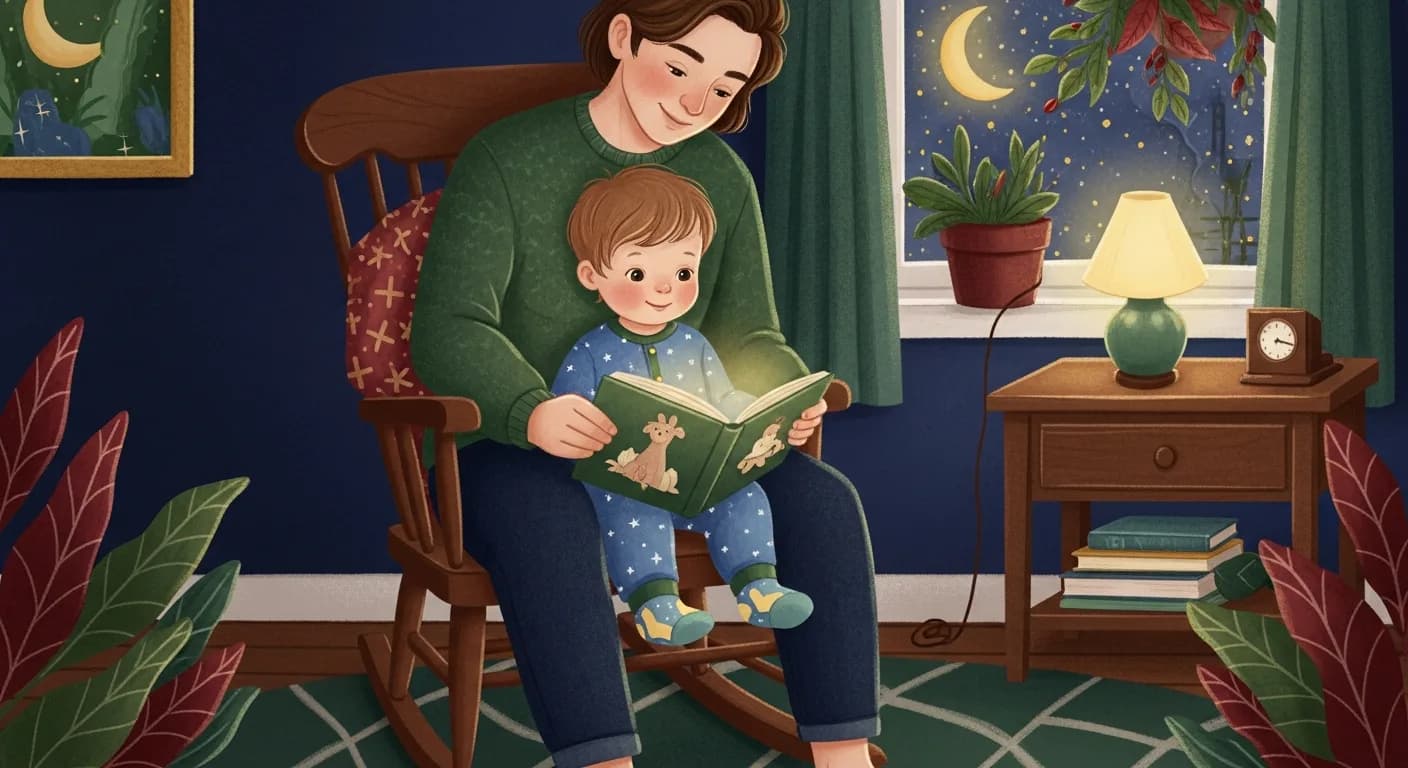
- Cozy, familiar settings: a cottage, a forest at dusk, a bedroom much like this one
- A small, manageable challenge resolved with warmth rather than triumph
- Sensory language that invites imagining textures and sounds rather than actions
- Endings that land somewhere safe: everything tucked in, everything at rest
- A single, lovable main character (and perhaps one friend) rather than a crowd
The best bedtime stories for toddlers have an almost lullaby quality — a rhythm you could almost hum, a world you want to stay inside for a while before the lights go out.
The Remarkable Power of Repetition
If your toddler has requested the same story every night for two weeks running, congratulations — you have found a good one.
Parents sometimes worry about repetition, concerned their child is not getting enough variety or that something is wrong. But developmental science is clear: for toddlers, repetition is not a sign of boredom or rigidity. It is a sign that the story is doing important work.
When toddlers hear the same story again and again, they are:
Building language. Each repetition deepens their understanding of vocabulary, sentence structure, and narrative sequence. They begin to anticipate phrases and finish sentences — which is a genuinely important developmental milestone.
Practicing emotional regulation. A familiar story is emotionally safe. Toddlers know where the scary-ish moment comes, and they know it resolves well. Repeated exposure to that pattern — tension, then safety — quietly builds their capacity to trust that difficult things pass.
Constructing narrative understanding. Stories have a shape: beginning, middle, end. Toddlers internalize this shape through repetition, which is foundational for later literacy and comprehension.
Feeling in control. Toddlerhood is full of things happening to you. A story you know so well you can predict it is a small island of agency. Your child controls what happens next, because they already know. This is not nothing.
So lean into repetition. The story is not wearing out. It is wearing in.
Practical Tips for Toddler Bedtime Story Success
Create the Container Before the Story Begins
The story works best when it is the capstone of a settled routine, not the thing you reach for in desperation at 8:15 when nothing else has worked. A warm bath, a small snack, quiet time in the bedroom — these things lower the baseline activation level, so the story does not have to do all the heavy lifting.
Use Your Voice as an Instrument
At bedtime, your read-aloud voice should be about thirty percent slower and twenty percent quieter than your normal reading voice. This is not about being boring. It is about using pace and volume as signals. We are slowing down. The day is settling. Toddlers are extraordinarily attuned to these vocal cues.
Choose Stories That Include Sleep or Rest
There is something quietly powerful about a story that ends with a character going to sleep. The narrative makes sleep feel like the natural, desired conclusion — not a demand being placed on your child, but the thing all beloved characters do at the end of a good day. Look for stories where the final image is a tucked-in creature, a moon going quiet, or a village settling into peaceful dark.
Let Them Hold Something
A favorite stuffed animal, a soft blanket pulled close — having something to hold engages the hands and body in a gentle way that can actually help toddlers settle. The tactile anchor is part of the ritual's comfort.
Try Personalized Stories for Extra Magic
One of the most reliable ways to hook a toddler's attention at bedtime is to make the story about them. When your little hero hears their own name — their actual name, woven through the adventure — something lights up that ordinary stories cannot quite reach.
Personalized bedtime stories are particularly effective with toddlers because the identification is instant and total. There is no need to explain that the character is "kind of like you." The character is them, and the delight on their faces is something you will want to see every night. Discover how personalized stories work their magic and why parents call them the best upgrade to storytime they have ever made.
When Nothing Seems to Work
Sometimes bedtime is just hard, and even the best story cannot fully bridge the gap between an overtired, overstimulated toddler and sleep. A few things worth noting:
An overtired toddler is often harder to settle than a moderately tired one. If bedtime is consistently a battle, look at whether the overall timing needs to shift earlier.
A story that is too long can actually make things worse — as a toddler's tiredness tips past a certain point, their capacity to engage with narrative collapses, and the story becomes something to fight against rather than drift into.
Sometimes the answer is no story at all — just a quiet song, some gentle back-rubbing, and a soft voice in the dark. There are nights when the ritual itself is enough.
The Gift of the Bedtime Story
The bedtime story is one of the small, consistent gifts that quietly shapes a childhood. Not in dramatic, visible ways — but in the way that warmth and repetition and being listened-to at the end of every day eventually becomes the feeling of being deeply, ordinarily loved.
Your toddler will not remember most of the stories you read them. But they will carry the feeling of those evenings — the lamp, the closeness, the voice — in ways that never fully leave.
Choose the stories with care. Show up for the ritual. And trust that even the most ordinary evening of "one more, please" is a kind of small magic in itself.
Looking for the perfect personalized bedtime story for your toddler? OnceUponMe creates custom stories featuring your child's name, interests, and world — crafted to the gentle pace and warmth that makes bedtime work beautifully.
Curious about audio stories as an option for your toddler's routine? Read our piece on audio bedtime stories and why they work so well.