Audio Bedtime Stories: A Modern Twist on a Timeless Tradition
Audio bedtime stories offer a screen-free way to spark imagination, build listening skills, and ease children into sleep — even when you can't be there to read aloud.
6 min read
Audio Bedtime Stories: A Modern Twist on a Timeless Tradition
Long before books, there were voices in the dark.
Storytelling began as something spoken, not written — a human voice reaching across a fire, shaping the night with words and rhythm and the particular warmth that comes from a story shared in close company. Children fell asleep to those voices for thousands of years before the first picture book was ever printed.
Audio bedtime stories are, in that sense, one of the oldest things in the world wearing a modern costume. And right now, for a lot of families, they are becoming one of the most beloved parts of the evening routine.
Here is why they work — and how to make them work beautifully for your child.
The Screen-Free Advantage at Bedtime
One of the most pressing challenges of raising children in a screen-saturated world is bedtime. Screens emit blue light that actively disrupts melatonin production — the hormone that signals to the brain that it is time to sleep. Even a brief burst of screen time in the hour before bed can meaningfully delay the onset of sleep and reduce its quality.
Audio bedtime stories offer a genuinely screen-free alternative that does not feel like a deprivation. For children who are used to being entertained visually, the transition to pure audio can feel like a gift rather than a rule — because a good audio story asks the imagination to do something that no screen ever can.
It asks the mind to make the pictures.
And that making — that quiet, internal act of world-building while a voice guides the narrative — is one of the most nourishing things a child's developing brain can do.
What Listening Does for a Child's Developing Mind
We talk a lot about reading as a developmental skill, and rightly so. But listening is the foundation that reading is built on, and it deserves its own moment of recognition.
Listening Builds Language From the Inside Out
When children hear stories — spoken aloud with warmth, pacing, and expression — they absorb language at a different depth than when they see it on a page. They are receiving not just the words but the music of the words: the rhythm of a sentence, the weight of a pause, the way a character's voice shifts when they are frightened or joyful.
This is how children internalized language for millennia before literacy became widespread, and it remains one of the most effective pathways to rich vocabulary, strong comprehension, and the instinctive sense of how stories are shaped.
Listening Grows the Attention Span
Sustained listening — following a narrative without visual support — is a genuine cognitive workout. It asks children to hold information in mind, to track characters and events, to anticipate and infer. Done regularly, audio stories build the kind of focused, patient attention that serves children across all of their learning.
There is something particularly valuable about the fact that listening requires a different kind of attention than watching. There is nothing to look at. The engagement has to come entirely from within — and children who practice this regularly develop a quality of inner focus that is becoming increasingly rare.
Listening Fires the Imagination
When a child watches a story, the images are provided. When they hear a story, they have to build the world themselves. The forest the narrator describes becomes the child's own private forest, constructed from their particular experience of green and shadow and the smell of rain on leaves.
Every child who listens to the same audio story builds a completely different version of it inside their mind. That variation is not a bug. It is the whole point. Imagination is a muscle, and audio stories are one of its finest workouts.
When You Cannot Be There: The Gift of a Familiar Voice
There is a particular tenderness to the role that audio bedtime stories can play when a parent cannot be the one at the bedside.
Work travel. Medical stays. Shared custody arrangements. The ordinary, sometimes painful logistics of modern family life mean that there are nights when the parent who usually reads the story is not there to read it. For children who have built a bedtime ritual around storytime, that absence is felt in a real and specific way.
A recorded audio story — especially a personalized one, where the story features your child's own name and the details of their world — can bridge that gap in a way that is genuinely comforting rather than just functional. The warmth of a familiar narrative voice, even through a speaker, carries something of the ritual's safety.
Some families create their own recordings: a parent reading a favorite story into a phone before a trip, so the child can play it back at bedtime. Others use professionally crafted audio stories that bring the same warmth and care to the narration. Either way, the continuity of the ritual is preserved — and that continuity matters more than the medium.
The Imagination Workout: Why Audio Beats Screens for Nighttime
We touched on imagination above, but it is worth dwelling on this a little longer, because it is perhaps the most underappreciated gift that audio bedtime stories offer.
Screens are generous. They provide everything — the images, the motion, the colors, the facial expressions, the world completely rendered. This generosity has a cost: there is very little left for the viewer to do. The mind becomes a consumer rather than a creator.
Audio stories are different. They provide just enough — a voice, a narrative, perhaps some gentle music or ambient sound — and they leave the rest to you. The child listening to a story about a little girl named Maisie who discovers a door in an oak tree does not receive Maisie's face; they invent it. They do not see the door; they conjure it, in whatever wood and whatever color the story's atmosphere suggests to them.
This act of conjuring is not passive. It is intensely active — which might sound paradoxical for something we are hoping will ease a child toward sleep. But here is the interesting thing: the internal, quiet activity of imaginative visualization is actually one of the most effective natural pathways into sleep. The mind is engaged enough to pull away from the stimulation of the day, but the engagement is inward and self-contained, not reactive to external input.
Many children who struggle to "turn their brain off" at bedtime — who lie awake restless and overstimulated — find that an audio story gives their mind something to do that is calm enough to drift into sleep from.
Combining Audio Stories With Reading: A Partnership, Not a Competition
Some parents worry that audio bedtime stories might replace reading, or reduce the incentive to learn to read independently. The worry is understandable, but the evidence suggests the opposite is true.
Children who are read to and who listen to stories regularly develop stronger foundations for independent reading — not weaker ones. The language patterns absorbed through listening become the internalized templates that make decoding written text more intuitive. The love of narrative developed through listening becomes the motivation to access more of it, which is exactly what drives children toward books.
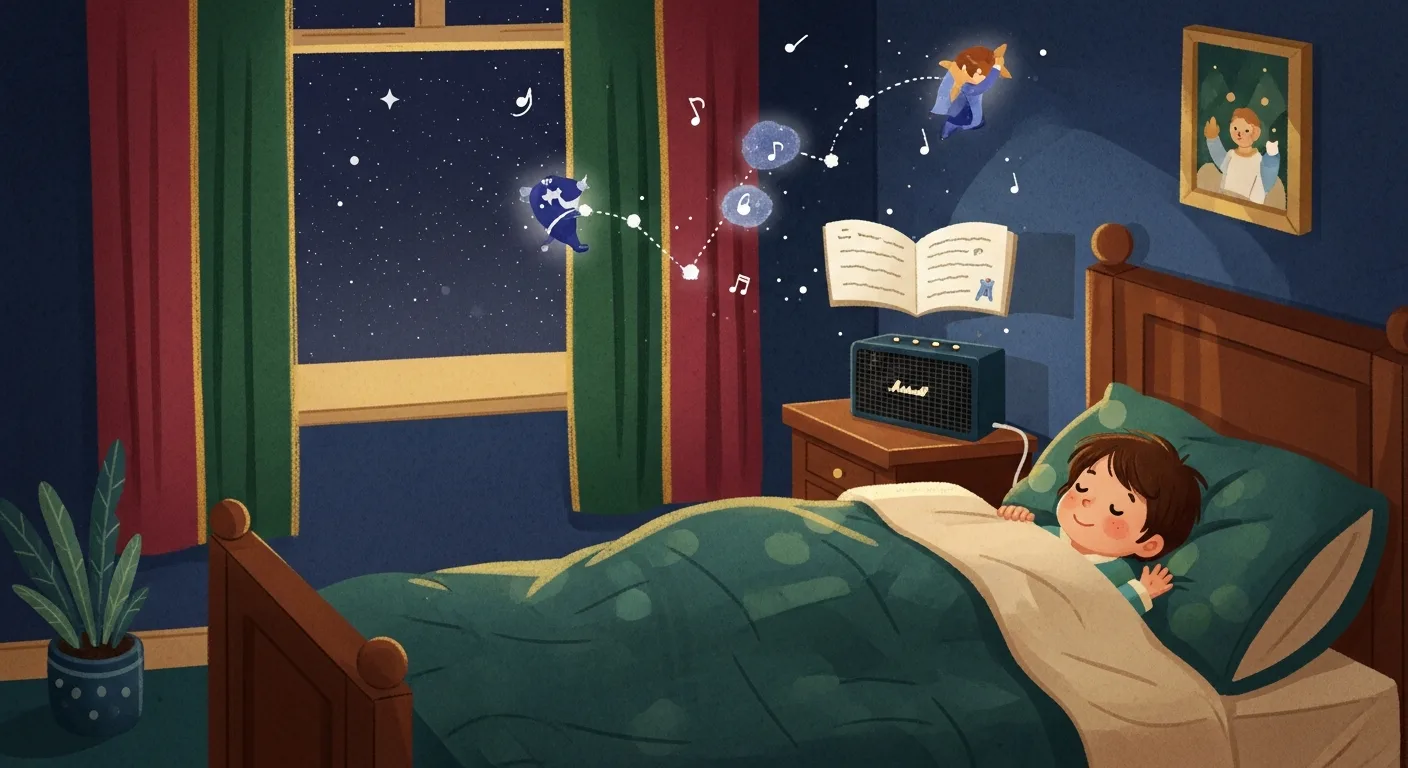
The most powerful combination is to treat audio stories and read-aloud stories as companions rather than substitutes. Perhaps some evenings you read together from a physical book. Perhaps other evenings you listen to an audio story side by side, sharing the experience in a different way. Perhaps an audio story plays in the background while your child drifts toward sleep after you have already said goodnight.
All of these patterns build the child's relationship with story, language, and the particular peace of bedtime as a narrative space.
What Makes an Audio Bedtime Story Work Well
Not all audio stories are created equal when it comes to the specific demands of bedtime. Here is what to listen for:
Pacing and Rhythm
The narration should feel unhurried — almost leisurely — in a way that signals safety and settledness. Stories that race through their plot, or that vary dramatically in pacing, keep the nervous system alert when you want it to be softening. Look for narrators who breathe into the story, who let sentences complete before moving on.
Vocal Warmth Over Performance
A great bedtime audio story is not an audiobook performance. It does not need dramatic character voices or theatrical highs and lows. What it needs is warmth — the quality of a voice that sounds like someone who genuinely loves the child they are reading to. That warmth is felt even when the specific words are not fully tracked, and it is one of the reasons children can drift into sleep mid-story and still be comforted by the voice continuing.
Gentle Sound Design
Some audio stories include ambient sound or soft music, and when done well, this is genuinely lovely. The sound of gentle rain, a quiet forest, a soft and meandering melody — these environmental sounds deepen the immersion without adding stimulation. The key word is gentle. Any sound that punctuates suddenly or escalates noticeably will disrupt rather than deepen the settling process.
A Satisfying Ending
Even if a child falls asleep before the story finishes — and many will, which is the point — the story should have an ending worth hearing if they stay awake for it. A resolution that feels complete and safe, a final image that is soft rather than exciting, a sense that the world of the story is settled and at peace.
Personalized Audio Stories: Where the Magic Multiplies
The pleasures of audio bedtime stories and personalized stories come together in a particularly wonderful way when you combine them.
Imagine your child lying in the dark, eyes closed, hearing a voice tell the story of their own adventure — their name woven through the narrative, their favorite things making small appearances in the world of the story, a character who looks like them (in their imagination, vividly) going on a journey that is somehow just right for them.
This is the experience that personalized audio bedtime stories offer, and it is quite distinct from both ordinary audio stories and ordinary personalized books. The combination of the child's name spoken aloud with the immersive quality of pure audio creates an identification that is remarkably deep — a sense that the story is not just for them, but somehow about the truest things about who they are.
At OnceUponMe, we craft personalized bedtime stories that carry this quality — warm, imaginative, paced for sleep, and built around the specific details of your little hero's world. Learn more about how our personalized stories work, or explore our guide to bedtime stories for toddlers if you want to find the perfect fit for your youngest listeners.
The Voice in the Dark
There is something quietly profound about a voice telling a story to a child in the dark.
It reaches back to the very beginning of human childhood — to the voices that have always, in every culture and every century, been the last thing a child hears before sleep. The technology has changed. The magic has not.
Your child deserves a voice that speaks just for them, a story that is theirs alone, and a bedtime that feels like a gentle adventure rather than the end of something.
That voice is waiting. Tonight is a good night to let it tell its story.
Discover the world of personalized audio bedtime stories at OnceUponMe — create your child's first personalized story today and hear the difference a name can make.