Keeping Kids Entertained on Trips: Stories That Travel with You
Road trips, flights, and long car rides all go smoother with the right stories. Here's how to turn travel time into the best story time.
7 min read
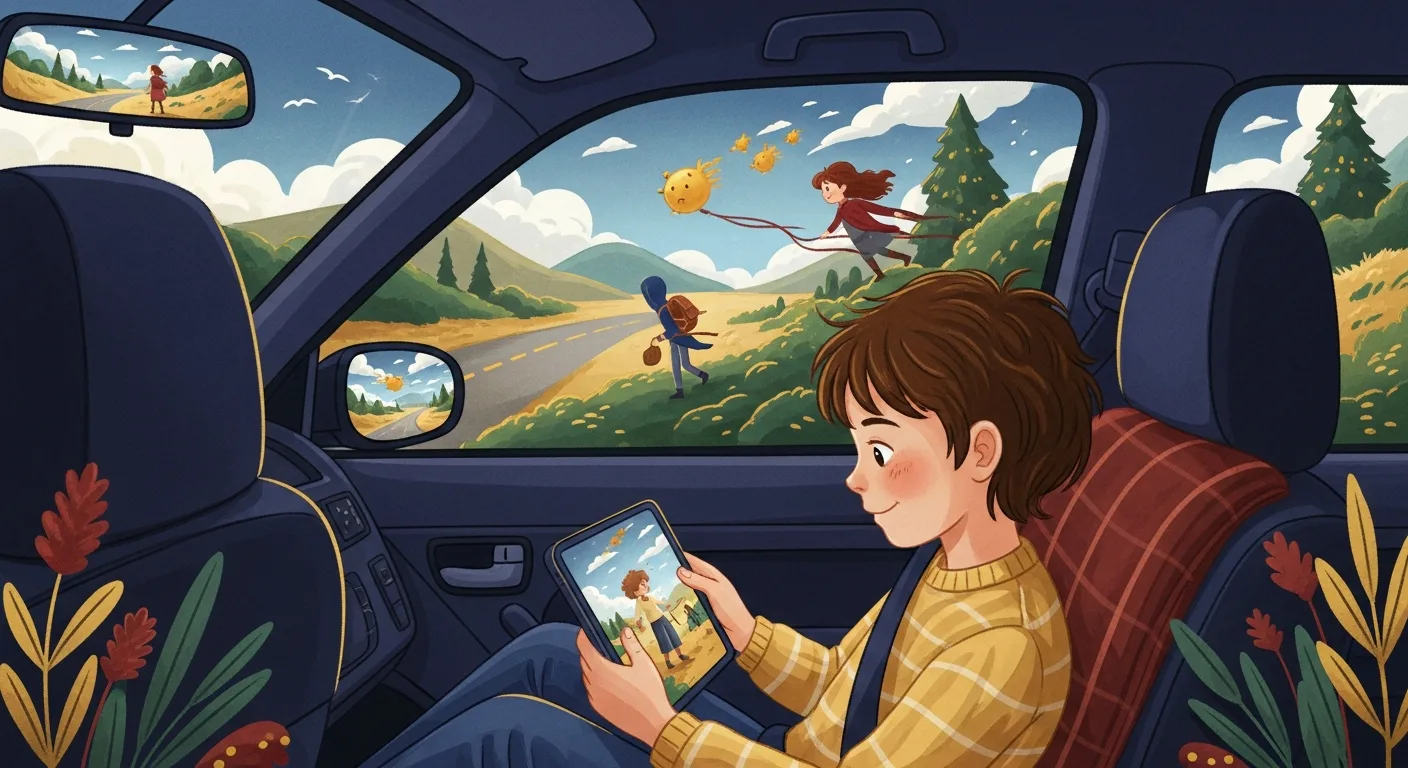
Keeping Kids Entertained on Trips: Stories That Travel with You
The question arrives approximately forty-five minutes into every family road trip, delivered with the particular emphasis that only a child can muster: "Are we there yet?"
It doesn't matter how long the drive is. It could be two hours or twelve. It could be a flight to another continent or a forty-minute trip to grandma's house. At some point, the snacks have been eaten, the window views have lost their novelty, and the back seat energy is building toward something nobody wants.
Stories are the oldest and most effective solution to this problem that humanity has ever found. Long before screens, before headrest DVD players, before tablets loaded with games, storytelling was how families passed the time on long journeys. It's still the best answer we have — and in the age of audio stories and personalized adventures, it's better than ever.
This guide is for every family heading somewhere, near or far, who wants the journey to be part of the adventure.
Why Stories Work So Well on the Road
There's something about being in motion that primes a child for story. Enclosed in a car or plane, with familiar scenery replaced by the unfamiliar, the imagination is already warmed up. The brain is processing newness and novelty — and a good story feeds that same hunger.
Unlike a screen, a story (whether read aloud or listened to) keeps a child's mind actively engaged rather than passively receiving. They're building images, tracking characters, predicting what comes next. That mental activity means time genuinely passes more quickly — not because they're numbed, but because they're absorbed.
And for parents, there's an added bonus: a story playing through the car speakers is a shared experience. You're all in it together. You can react to the same plot twist. You can pause it and say "Wait, do you think she's going to..." and watch your child's face light up with their theory. That's conversation. That's connection. That's the kind of thing families remember long after they've forgotten whether the trip itself was delayed.
Road Trip Storytelling: Starting the Engine Early
The road trip story works best when you treat it like an event, not an afterthought.
Announce the story before you leave
Tell your children that you have a special road trip story waiting for them. Build it up a little. "This one is about a kid who discovers a secret map in the back of an old campervan." Let them be curious before the journey even starts. Anticipation makes the first chapter hit harder.
Use chapter-based audio stories
For longer drives, a serialized story — one with natural chapter breaks — works beautifully. Each chapter is its own small reward. When you stop for a break, you're stopping "right before the next part," and suddenly getting back in the car has a different energy entirely.
Bring physical books for when you stop
Long drives have natural breaks — petrol stations, picnic areas, restaurants, viewpoints worth pulling over for. Pack a small selection of your child's favorite books, along with one or two new ones. The new ones become little gifts that get unwrapped at rest stops and then read in the car as you pull away.
Flying with Children: Stories Over Screens
Airports and planes present a particular challenge. The combination of confined space, overstimulation, disrupted sleep schedules, and the genuine unpredictability of air travel can make even the most seasoned child traveler frazzled.
Screens get defaulted to in these situations, and sometimes that's absolutely fine. But stories — especially audio stories — have some advantages that screens don't.
Audio stories don't require eye contact with a bright screen
For take-off and landing, for the moment the cabin lights dim, for the half-sleeping stretch between cities: a story playing through earphones or a small Bluetooth speaker (if the seat allows) lets a child be absorbed without straining their eyes or disturbing their natural wind-down.
Stories travel through turbulence
There is something remarkably calming about a familiar voice telling a familiar story during a bumpy patch. The narrative continues regardless of what the plane is doing, and that continuity is itself soothing. Many parents report that a well-chosen story has carried their child through turbulence that would otherwise have caused significant anxiety.
Build an audio playlist before you leave home
Rather than scrambling at the gate, create your travel story playlist during the week before the trip. Include your child's current favorite stories, one or two they haven't heard yet, and — if you can — at least one story that connects to where you're going.
Stories About the Destination: The Magic of Anticipation
Here's a travel storytelling strategy that doesn't get nearly enough attention: stories about where you're going.
If your family is travelling to the coast, find a story set by the sea. If you're headed to a mountain cabin, find one set in the woods. If you're visiting a different country or a city with a distinct character, look for a story that lives in that world.
What happens is remarkable. The fictional place and the real place begin to overlap in a child's imagination. When they finally arrive at the beach, they're not just seeing sand and waves — they're stepping into the world of the story. The real place becomes richer, more charged with meaning, because narrative has been there first.
Creating a story about the destination
You can take this even further by creating a story that is explicitly about your trip — a story in which your little hero sets off on an adventure to the very place your family is visiting. The story might echo the real itinerary: the long drive there, the funny thing that happens at the first rest stop, the moment they first see the ocean.
When the story mirrors the journey, the journey becomes the story. That's a gift of a different order entirely.
At OnceUponMe, we make exactly this kind of personalized travel story — crafted around your child's name, the destination you're heading to, and the spirit of adventure that every trip deserves. Imagine playing a story in the car that begins: "On the morning the family drove to the sea, [your child's name] knew something extraordinary was about to happen..." The back seat goes quiet. The question "Are we there yet?" gets replaced with "What happens next?"
Packing a Portable Library
Alongside digital audio, physical books still have a place in travel — maybe more of a place than ever, precisely because they require nothing: no battery, no WiFi, no download.
What to pack
A handful of old favorites. The comfort of a known story is particularly valuable when everything else about the environment is unfamiliar. A beloved book is a piece of home that fits in a bag.
One or two new picks. New books are small adventures in themselves. Save one for the plane, one for the first night in the new place.
A travel journal that doubles as a storybook. For older children, a blank journal where they write or draw the story of the trip as it happens is a project that spans the whole journey. By the time you return home, they have their own personalized travel narrative — something that can be read and reread for years.
Age-appropriate options for every leg. Toddlers need different things from eight-year-olds. Pack accordingly: board books and lift-the-flap books for the littlest travellers, chapter books and activity books for older ones.
Making the Journey Part of the Story
The deepest shift you can make in family travel is this: stop treating the journey as an obstacle between home and destination, and start treating it as the first chapter of the adventure.
Stories help with this more than almost anything else. When the car itself becomes the vessel of a great tale — when the miles are marked not by rest-stop signs but by plot points and chapter breaks — the journey takes on its own meaning.
Children who experience travel as story tend to become adults who see the world as narrative. Every place has a story. Every trip is an adventure. That's not a small gift. That's a way of moving through the world.
You can extend this philosophy all the way home with our post on making bedtime stories interactive — because the conversations that happen during a trip, and the stories told after, are part of the same long tale.
Your Story Is Already in Motion
Whether you're leaving for a weekend or a month, whether you're driving two hours or flying across an ocean, your family's journey is already a story. It has a beginning (the packed bags, the early alarm, the loading of the car), a middle (the miles, the meals, the unexpected moments), and an end (the return home, tired and full of things to say).
Your little hero is the main character of every trip you take together.
Why not give them a story to match?
Visit OnceUponMe and create a personalized travel story for your next adventure. One where your child sets off into a world built just for them — and every mile of the journey brings them closer to something wonderful.