Raising a Reader: Habits That Start Before They Can Read
A love of reading doesn't begin with chapter books. Discover the gentle, joyful habits that build lifelong readers from the very beginning.
7 min read
Raising a Reader: Habits That Start Before They Can Read
There's a particular kind of magic in watching a child fall in love with books. The way they insist on the same story for the fourteenth night in a row. The way a toddler "reads" a picture book they've memorized, turning the pages at exactly the right moment, reciting the words with total confidence. The way a five-year-old who can't yet decode a single letter will nevertheless carry a book around all morning, absorbed in the pictures, constructing their own version of the story.
That love doesn't arrive on the first day of school. It doesn't switch on when a child sounds out their first word. It grows in the years before — quietly, steadily, from hundreds of small moments that most parents don't even recognize as literacy education.
This is the story of those moments. And it starts much earlier than you might think.
Before They're Born: The Reading Womb
It sounds almost too soft to be true, but the evidence is there: reading aloud during pregnancy does something.
The human auditory system begins developing in the womb around eighteen weeks. By the third trimester, a fetus can hear and respond to their parent's voice. Studies have shown that newborns already prefer the sound of their mother's voice to a stranger's — and that they show recognition of stories read repeatedly during pregnancy.
Reading aloud while pregnant isn't about downloading vocabulary into a pre-born brain. It's about something simpler and stranger: the voice. Your voice, reading. Your particular cadence and warmth and the way you slow down at a good sentence. That voice becomes familiar before the world outside the womb does. And when you read to your newborn in those first weeks, they already know it.
This is about as early as literacy habits can possibly begin — and it is, by any measure, the gentlest possible start.
Board Books for Babies: It's Never Too Early
The board book is one of the most underrated objects in early childhood. Chunky, chewable (and they will be chewed), virtually indestructible — these little books are designed for the hands that will encounter them.
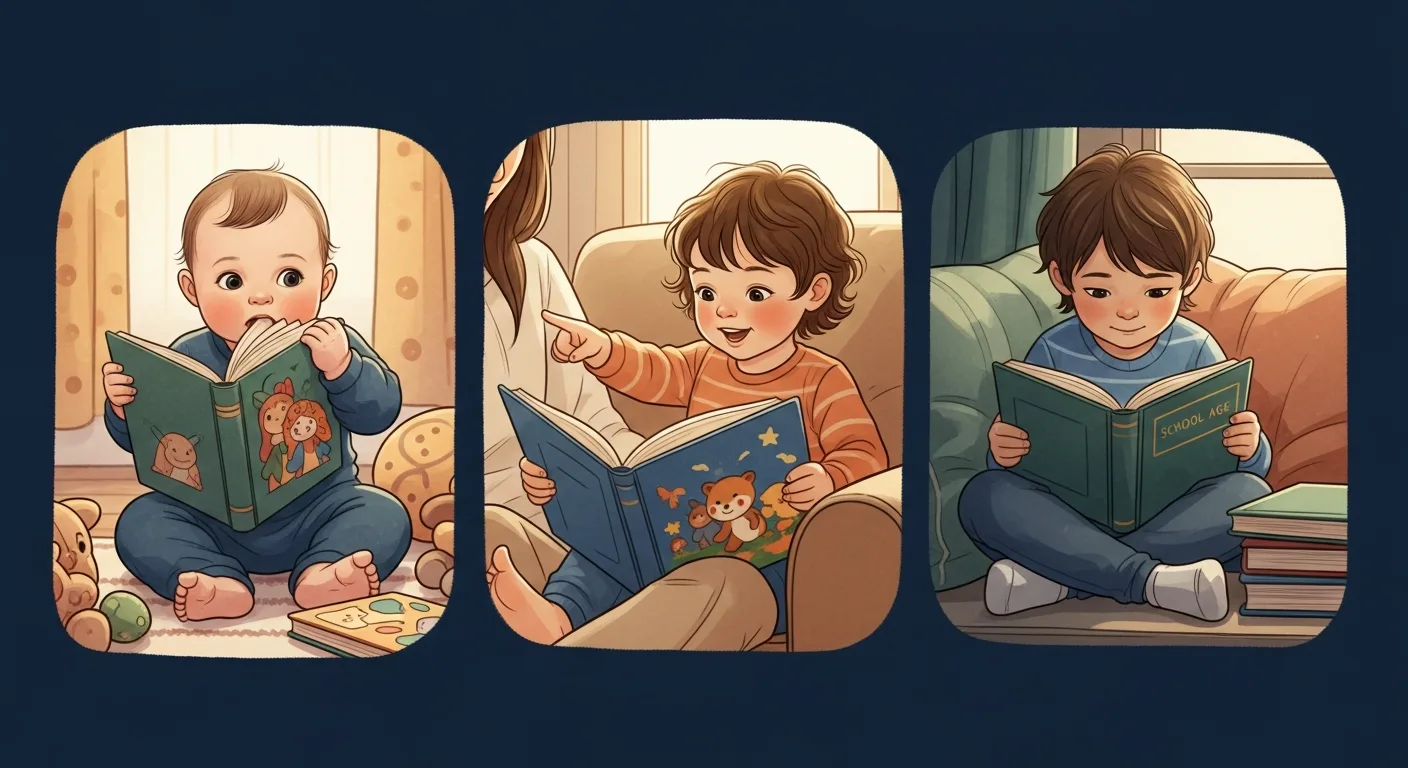
Babies don't "read" board books the way we understand reading. They hold them. They taste them. They stare at the high-contrast images. They look at your face as you read, tracking your expressions more than the words. And slowly, over hundreds of sessions that feel entirely unremarkable in the moment, they begin to associate books with warmth, with closeness, with the sound of a beloved voice.
What to look for in baby books
For very young babies: high contrast images, simple shapes, faces. For babies around six months and up: bright colors, familiar objects, textures to feel. For babies approaching their first birthday: books with rhythm and repetition — the kind where the pattern becomes predictable and the brain begins to anticipate the next word.
That anticipation — leaning into the rhythm of a text — is one of the earliest and most important pre-literacy skills. Every time a baby's face lights up because they knew what word was coming, something real is happening.
Environmental Print: The World Is Already Full of Stories
Before a child can read a single book, they are surrounded by text. Cereal boxes. Street signs. Shop names. Labels on everything in the kitchen. The writing on your coffee cup.
This is called environmental print, and it is a child's first real window into the idea that marks on a surface carry meaning. When a three-year-old recognizes the golden arches or the logo on their favorite cereal, they are doing something genuinely remarkable: they are decoding symbols. They are reading.
How to nurture environmental print awareness
Point to words as you encounter them. "That sign says STOP — see how those four letters spell stop?" Read the menu out loud at a restaurant. Let them see you read a recipe while cooking. When you pass a shop they recognize, ask how they knew what it was. ("The letters! What letter does it start with?")
None of this needs to be a lesson. It just needs to be noticed, casually, in the flow of ordinary life.
Modeling Reading: The Most Powerful Thing You Can Do
Here is something that gets said too rarely: a child who sees adults reading for pleasure is far more likely to become a reader than a child who is simply read to.
Books that exist only as a child-directed activity send a quiet message: reading is for children. But a parent who reads their own novel, who goes to a library for their own reasons, who talks about a book they're enjoying — that parent sends a completely different message: reading is what interesting people do. Reading is a pleasure worth choosing.
Small ways to model reading
Put your own book on the nightstand and mention it at dinner. Read the newspaper or a magazine in a place where your child can see you. Talk about what you're reading in the same way you'd talk about a film you enjoyed. Go to the library together — and check out something for yourself, not just for them.
You don't need to perform your love of reading. You just need to actually do it, visibly, sometimes.
Letting Them Choose: The Secret Ingredient
One of the most common well-intentioned mistakes parents make is steering their child toward "educational" books rather than books their child actually wants.
The child who is obsessed with diggers and reads nothing but books about construction equipment is building vocabulary, comprehension, and reading stamina just as effectively as the child reading classical fairy tales. The child who wants to read graphic novels is reading. The child who wants the same three books repeatedly is reading. The child who wants to read the catalogue that came in the post because it has pictures of dogs in it — is also reading.
Passion is the engine. The subject matter is almost irrelevant.
How to honor their choices without completely surrendering yours
A good rule of thumb: let them choose freely most of the time, and introduce new things gently and occasionally. Bring home a book you think they'll like and put it somewhere they'll find it — don't make a production of it. Read it yourself first and leave it visible. Curiosity is more powerful than recommendation.
And when they want the same story for the twentieth time: read it. The repetition is doing something. They're memorizing it, internalizing its structure, owning it. That's not boredom — that's deep reading.
Never Forcing, Always Inviting
The fastest way to make a child not want to read is to make reading a battleground.
Reading time that becomes a test, a correction, a performance review — that reading time is actively working against itself. The same child who would happily sit for twenty minutes with a book they chose will dig in their heels immediately if they sense that their reading is being evaluated rather than enjoyed.
This doesn't mean never helping with phonics or never gently correcting a misread word. It means keeping the emotional temperature warm. Keeping the experience pleasurable. Keeping the question "would you like to read together?" genuinely optional, often enough that the answer yes means something.
Some children take longer to love books than others. Some children who seem indifferent to reading at four will be voracious readers at seven. The seeds you plant now — in cozy reading sessions, in audiobooks in the car, in stories before bed — are doing their work underground. They will surface.
The Long Game of Literacy
Raising a reader is not a sprint. It's one of the longest, most patient, most rewarding projects a parent can undertake — and almost all of it happens in moments so ordinary you won't notice them as they pass.
The board book read at 6am because they woke too early. The audiobook that played on the drive to the shops. The night you were exhausted and did three pages instead of a chapter. The library trip where they chose something you would never have chosen. The morning they sat quietly for twenty minutes with a book, not because you asked them to, but because they wanted to.
All of it. It all counts.
And the payoff is one of the most beautiful things childhood can produce: a child who lives in stories. Who knows that wherever they go, however they feel, whatever they're facing — there is a book somewhere that speaks to it. That waiting in the world for them, always, is another adventure.
You can read more about the early years of this journey in our post on personalized stories for toddlers — because there's a particular kind of early reading magic in a story that puts your little hero right at the center.
The Story That Starts With Their Name
Every child who loves reading arrived there through a story that first made them feel something. Curiosity. Delight. Recognition. Wonder. The story that does all of those things at once — the one that makes a child think this is about me, this is my world, I matter in this tale — is one of the most powerful reading experiences a young child can have.
That's what we build at OnceUponMe. Stories that are entirely, unmistakably about your little hero — their name, their character, their kind of adventure. Stories that don't just entertain, but invite a child into the experience of being a reader: absorbed, invested, alive to the page.
The long game of raising a reader starts with one story. It might as well be the best one they've ever heard.
Visit OnceUponMe and begin your child's story today.