How Stories Help Kids Navigate Big Life Changes
New sibling, moving house, starting school — big changes unsettle little hearts. Here's how the right stories can help kids understand and process them.
7 min read
How Stories Help Kids Navigate Big Life Changes
Something big is happening in your family. Maybe a new baby has arrived, or is about to. Maybe you are moving to a new town, a new house, a new school. Maybe your family looks different now than it did a year ago. Maybe someone important is gone.
Whatever the change, you have noticed the same thing that parents have noticed for as long as stories have existed: your child is struggling to put it into words. They act out instead. They go quiet. They ask the same question — "but why?" — over and over, not because they want the logical answer but because they are trying to find a way to hold the feeling.
Stories can help. Not because they give easy answers, but because they do something more valuable: they give children a shape for experiences that otherwise feel shapeless.
Why Stories Are Such Powerful Tools for Big Emotions
When something large and confusing happens in a child's life, they do not yet have the emotional vocabulary to process it directly. They cannot sit down and articulate "I am feeling anxious about the arrival of this new sibling because I am afraid my position in the family will change." What they can do is follow a small rabbit through a frightening forest, or cheer as a little dog finds his way home after getting lost, and feel — in their whole body — that the anxiety resolved, that the lost thing was found, that it worked out.
This is the essence of what therapists sometimes call bibliotherapy: the use of stories as a gentle pathway into difficult feelings. It is not new. Humans have always used stories to process the things that are too big for ordinary language. We wrote myths about death and loss and transformation thousands of years before we had clinical psychology. The instinct is ancient and it is correct.
For young children, stories work especially well because they create what psychologists call "safe distance." The feeling is real, but the character experiencing it is not them — which means they can observe it, explore it, and even influence it without the raw vulnerability of direct experience. They can be moved without feeling overwhelmed.
A New Sibling: The Story of a World That Changed Without Asking
Few changes land harder on a young child than the arrival of a new sibling. Everything shifts. Their position, their routine, their access to the people they love most. And they are expected to feel happy about it.
Stories about sibling arrivals do crucial work here. They validate the mix of feelings — the love and the resentment and the confusion — without telling a child they are wrong to feel any of it. A good story about a new sibling does not pretend that it is all wonderful from the first moment. It shows a child who felt unsure, who maybe felt a little left out, and who found their way through to something real.
When reading these stories with your little hero, resist the urge to use the story as a lesson. Just read it. Let them feel whatever they feel. The story is doing its work whether they say anything about it or not.
Moving House: Telling the Story of a New Beginning
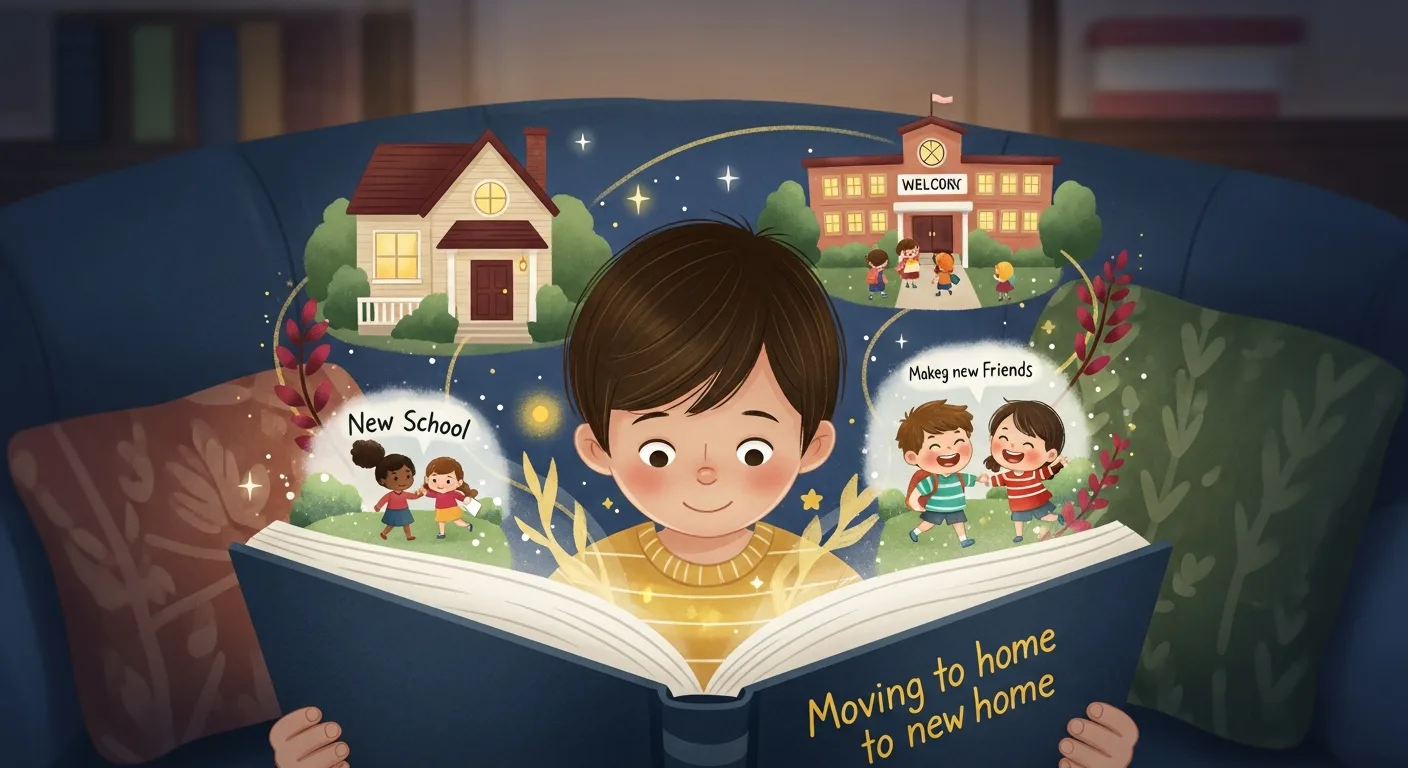
Moving is a big deal for children in ways that adults, who understand the reasons and the benefits, can underestimate. A child's world is intensely local. Their bedroom is not just a room. It is a fixed point in the universe. Their garden, their street, their school — these are the whole geography of their life.
Stories about moving tend to land best when they focus not on the destination (the exciting new house, the adventures ahead) but on the feelings of in-between. The packing of boxes. The saying goodbye. The strange first night in a new place that smells different.
A personalized story that places your little hero specifically in the moving experience — that names their old street, their new one, their feelings about both — can be a remarkable bridge. It tells them: this experience belongs to you, it has a shape, and there is a story where it comes out all right.
A note on "acting out" during transitions
If your child's behaviour seems to deteriorate during a big change, this is not misbehaviour in the usual sense. It is communication. The story time you create during this period — even just fifteen quiet minutes at the end of a chaotic moving day — sends a powerful message: no matter what else has changed, this has not. We still stop and read. We still have this.
Consistency in reading routines during upheaval is not a small thing. It is an anchor.
Starting School: The Enormous Unknown
Starting school is, for most children, their first genuine encounter with a world that exists entirely outside the family. Everything is unfamiliar — the sounds, the smells, the social rules, the enormous number of new people who all seem to know things they do not yet know.
Stories about starting school are so valuable here, but the best ones are specific rather than generic. Not just "school is fun!" but "you will feel nervous on the first day and that is completely normal, and here is a character who felt exactly what you are feeling and here is how they found their footing."
Look for stories that name the fear directly. "But what if no one wants to sit with me?" is a thought that visits nearly every child on their first day, and hearing a story character voice it can be profoundly relieving. Your child is not alone in thinking it. The story already knew they would think it.
Divorce and Family Change: Stories That Hold Complexity
When a family changes shape — through separation, divorce, or any other reorganisation — children need stories that are honest about complexity. They do not need stories that say it is fine when it is not entirely fine. They need stories that say: families come in many forms, love does not go away when arrangements change, and it is possible to feel sad about something and also find your way through.
This is terrain where gentle, well-chosen stories do genuinely important work. They normalise. They reduce shame. They show a child who might feel that their family is the only one that looks like this that other families look like this too, and those children are still loved, still whole, still the hero of their own story.
Reading these stories together opens conversations that might otherwise stay locked. A child who cannot say "I am scared you and Dad will stop loving me" might be able to say "why is the character in the book worried about that?" — and from there, the real conversation can begin.
Loss and Grief: Stories as a Gentle First Language
Grief is perhaps the hardest thing for a young child to process, because there is no resolution to offer. The person or pet or thing that is gone is gone.
What stories can offer is not resolution but companionship. A story about grief says: you are not alone in this, other hearts have felt this weight, and there are words — finally, words — for what you are carrying.
Children who are grieving often struggle most with the unspeakableness of it. The feeling is so large and so formless that it seems impossible to approach. A story gives it a shape. Not a neat ending, not a lesson, but a shape — and a shape is enough to begin.
Read slowly during these times. Allow silence after. You do not need to say anything wise. Often just being present together, in the world the story created, is the whole of what is needed.
How Personalized Stories Take This Further
All of the above applies to any well-chosen story. But there is an additional dimension that personalized stories bring to moments of big change: they put your child at the centre of the narrative in a way that makes the message feel directly and specifically addressed to them.
A personalized story about a child navigating a new sibling — one that uses your child's actual name, references their specific worries, and casts them as the capable, loved, central character — does something that a general picture book cannot quite do. It says: this story is about you. You are seen. And look at how it turns out for you.
This matters because children who are going through big life changes sometimes feel invisible inside their own experience. Everything is happening to them, swirling around them. A story that places them firmly at the centre, as the hero who navigates the change with heart and courage, restores a sense of agency that the change itself may have disrupted.
At OnceUponMe, you can create a story built specifically around the change your little hero is facing — new sibling, new school, a big move — woven with the details that make it unmistakably theirs. In a season of uncertainty, it is a gift that says: you belong in this story, and the story ends well.
You Do Not Need to Have the Answers
One final thing worth saying: when your child is going through something hard, you do not need to have the answers. You do not need to fix it or explain it away or make it feel better with the right words.
Sometimes the most powerful thing you can do is sit down with them, open a story, and read. The story will carry things you could not carry yourself. It has been doing that for human beings for a very long time, and it will do it for your little hero too.
Explore more about the power of reading together: how storytelling shapes child development and storytelling for anxious children.