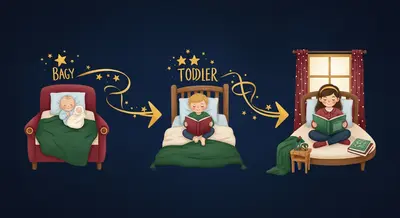
How Bedtime Stories Actually Help Kids Fall Asleep (It's Not Just Boredom)
Bedtime stories help kids sleep for real, science-backed reasons. Here's what's actually happening — and how to make story time work even harder for your family.
6 min read
How Bedtime Stories Actually Help Kids Fall Asleep (It's Not Just Boredom)
Let's be honest: most parents who read bedtime stories are at least a little bit hoping the story will do what it has always done, what generations of weary parents have quietly relied on. They are hoping it will work. They are hoping their little hero's eyes will grow heavier with each page, that the small body will soften against the pillow, and that by "The End" — or ideally just before it — sleep will have quietly arrived.
And the wonderful news is that this is not wishful thinking. Bedtime stories genuinely help children fall asleep, and not just because stories are occasionally a bit slow.
There are real, measurable things happening in your child's brain and body during story time. Understanding them doesn't make the magic disappear — it makes it richer.
The Problem with Bedtime (That Stories Help Solve)
Sleep doesn't arrive on command. You can put a child in a dark room in pajamas with a full belly and the best intentions in the world, and their brain — which five minutes ago was navigating a heated negotiation about the correct number of crackers in a bowl — will simply refuse to power down.
The reason is cortisol.
Cortisol is the stress hormone, the one responsible for keeping us alert, reactive, and ready to respond to whatever the world throws at us. It is enormously useful during the day. At bedtime, it is the enemy. And children — who experience intense emotional experiences throughout every hour of the waking day — often arrive at bedtime with cortisol levels that are nowhere near sleep-ready.
The task of a good bedtime routine is, in large part, a cortisol management task. You are trying to create the conditions in which your child's nervous system shifts from "alert and processing" to "safe and winding down." And a bedtime story is one of the most effective tools available for exactly this job.
What a Bedtime Story Actually Does to a Child's Brain
It Lowers Cortisol
When a child feels safe, warm, and cared for — held, or cuddled close, listening to a familiar and trusted voice — their body reduces cortisol production and begins releasing oxytocin instead. Oxytocin is the bonding hormone, the one associated with trust and comfort and connection. It is the physiological opposite of stress.
A bedtime story, read calmly by a parent, triggers exactly this response. The warmth, the closeness, the familiar rhythm of your voice — these are powerful physiological signals that say: you are safe, the day is done, you can rest.
It Narrows Attention
One of the challenges of falling asleep is that the mind keeps generating things to think about. For children, whose sensory and emotional processing is still maturing, this can mean a cascade of random thoughts, replayed moments from the day, anticipations about tomorrow, and questions about everything from whether their friend is still their friend to what dinosaurs sounded like.
A story narrows all of that down to a single thread: what is happening right now, in this world, on this page. The mind is occupied — but gently, with something that has no urgency, no demands, and a predictable shape. This is the cognitive equivalent of being ushered into a quiet room.
It Reduces Stimulation Gradually
Think of your child's brain at the peak of the day as a busy highway — full of fast-moving input, noise, interaction, and stimulation. Sleep requires something more like a country lane. You cannot jump directly from one to the other without a period of transition.
A bedtime story is that transition. Its pace slows. Its world is small and contained. Its images are formed slowly, in imagination, rather than flashing rapidly on a screen. The brain naturally begins to downshift in response.
The Power of Transition Rituals
Sleep scientists call them "transition rituals" — predictable sequences of events that the brain learns to associate with what comes next. For most children, a well-established bedtime routine is one of the most effective sleep interventions available, and it costs nothing and requires no special equipment.
The key word is "predictable." When the same events happen in the same order each evening, the brain starts preparing for sleep before sleep arrives. By the time story time begins, the body has already started producing melatonin in anticipation of the sequence it knows is coming.
This is why the bedtime story works better — often dramatically better — when it appears in the same place in the routine every night. It is not just a story. It is a signal. "This is the step before the last step. Sleep is close."
For a detailed look at building this kind of routine for your child's specific age, our guide on the perfect bedtime story routine for every age walks through exactly what this looks like from birth through early childhood.
The Voice Effect: Why Your Voice Specifically Matters
There is something particularly important about the fact that it is your voice reading the story.
Infants and young children are deeply attuned to the voices of their primary caregivers. Your voice carries a specific set of associations built up over years: safety, comfort, being cared for, being known. When your child hears you reading — not a recorded narrator, not a screen, but you — their nervous system responds to that familiarity in a way that is genuinely calming.
This does not mean recorded stories or audiobooks have no value. They absolutely do, especially as a practical bridge on nights when you cannot be there, or as a supplement to in-person reading. But the original, in-person version — your voice, your warmth, your presence — carries a weight that no recording can fully replicate.
The rhythm matters too. Calm, measured reading — not too fast, not too monotone, but steady and warm — has a pacifying quality that mirrors the gentle rhythms of breathing and heartbeat. Parents who read in a deliberately slower, quieter voice as the story progresses often find this small adjustment makes a noticeable difference to how quickly their child settles.
Stories as a Screen Replacement (and Why That Matters for Sleep)
The displacement effect of bedtime stories is worth examining on its own terms.
We know from sleep research that screens — televisions, tablets, phones — are among the most disruptive elements in a child's bedtime environment. Blue light suppresses melatonin production directly. But equally important is the content: screens deliver rapid, stimulating input that keeps the brain in exactly the alert state you are trying to move away from.
A bedtime story replaces that stimulation with something that moves in the opposite direction. Where a screen accelerates, a story decelerates. Where a screen demands attention with novelty and movement, a story invites attention with stillness and the slow unfolding of narrative.
Families who shift from screen time to story time at bedtime frequently report improvements in how quickly their children fall asleep and how settled they are overnight. This is not coincidental — it is the predictable result of replacing cortisol-maintaining stimulation with cortisol-reducing calm.
The Role of Predictability in the Story Itself
There is a beautiful paradox in what children ask for in bedtime stories: they often want to hear the same story again. And again. And again.
This repetition is not boredom — it is comfort. A story whose ending your child already knows is a story whose ending they do not have to worry about. There is no tension to lie awake resolving, no cliffhanger to replay. The shape of the story is known, and knowing it is safe.
This is one reason that personalized bedtime stories — which your little hero comes to know and love over repeated readings — work so beautifully at sleep time. The story becomes a familiar world, a place your child has visited before, where they know the rules and the outcome. That familiarity is its own kind of lullaby.
At OnceUponMe, the personalized stories we create are designed to be exactly this kind of companion — warm, familiar, and made for your child specifically. When your little hero's name is woven through the adventure, the story becomes something they can carry with them into sleep.
Practical Tips for Making Bedtime Stories Work Harder
Here is how to optimize story time for the best sleep outcomes.
Sequence It Consistently
Story time should always land in the same spot in the routine — after the physical steps (bath, pajamas, teeth) and before the final lights-out. This positioning trains the brain to associate story time with the onset of sleep.
Slow Your Voice as the Story Progresses
Begin at your normal pace and gradually read more slowly and quietly as you approach the end. You are physically modeling the pace you want your child's brain to match.
Choose Calm, Not Thrilling
Save the high-stakes adventure stories for earlier in the evening. At bedtime, gentle adventures with resolved endings, familiar characters, and warm emotional tones work better than stories with unresolved tension or shocking plot twists.
Keep the Room Dark and Warm
The physical environment works with the story. Dim light, comfortable temperature, and soft bedding all contribute to the cortisol reduction story time is trying to create. A bright overhead light actively works against it.
End Gently
When the story ends, stay for a moment. A quiet minute, a gentle goodnight, a moment of stillness — this is the bridge between the story world and sleep. Rushing out immediately can undo some of the settling you have worked to create.
A Note for Nights When There Is No Time
On the nights when life intervenes and story time shrinks to five minutes, or even three — the ritual still counts. A very short story, told calmly and warmly, still creates the cortisol drop, still signals the transition, still gives your child your voice and your presence.
You do not need to be perfect. You just need to show up. Our guide on short bedtime stories for busy parents is full of ideas for making even the briefest story time meaningful.
Story Time is Sleep Science You Can Actually Use
There is something deeply satisfying about discovering that the thing you have been doing out of instinct and love is also, it turns out, exactly what the science recommends.
Bedtime stories help children fall asleep because they lower cortisol, create transition rituals, slow stimulation, replace screen-driven arousal with calm narrative, and deliver the specific calming signal of your voice. They are one of the most effective, side-effect-free sleep tools a family has.
And they are also, of course, wonderful. The two things are not separate.
If you would like to give your little hero a bedtime story made just for them — personalized, warm, and crafted for exactly this magic moment — visit OnceUponMe and create their story today. Because the best sleep of their life might begin with hearing their own name in a story.