How to Build a Daily Reading Habit with Your Child
Build a daily reading habit with your child that actually sticks—gentle strategies for habit stacking, consistency, and celebrating reading milestones.
6 min read
How to Build a Daily Reading Habit with Your Child
Nobody builds a daily reading habit on willpower alone. Not adults, and definitely not children. If you have ever set a grand ambition to read with your child every single night and then found yourself, three weeks later, sheepishly noting that the book has moved to the nightstand permanently because it is easier to sit on than to open—you know exactly what this means.
Habits are not about motivation. They are about structure, and about making the behavior you want so easy, so woven into the shape of the day, that doing it requires less effort than not doing it.
The good news: daily reading with your child is one of the easiest habits to actually build—once you understand what makes habits stick. Here is how.
Start With Small, Then Protect It Fiercely
The most common mistake in building a reading habit is starting too big. Ten pages a night sounds reasonable on a Sunday when you are full of good intentions. On a Tuesday when dinner was late and someone had a meltdown over homework and the dog has done something unspeakable in the hallway, ten pages feels like a summit expedition.
The Five-Minute Rule
Start with five minutes. Not as a minimum—as the entire goal. Five minutes of reading together, every single day, is an extraordinary thing. Across a year, that is more than thirty hours of shared story time. More books completed than most adults read in a year. Hundreds of conversations sparked by what happened on the page.
Five minutes feels laughably small. That is exactly the point. Small goals get done. They survive the hard days. They build the habit underneath before the habit has to carry any real weight.
Once five minutes is automatic—once you both reach for the book without thinking about it—it will naturally, quietly expand. Not because you decided to increase it, but because you are both already there, and the story is good, and neither of you wants to stop.
Non-Negotiable, But Never a Punishment
The daily reading habit needs to be consistent enough to become reflexive—which means treating it as non-negotiable in the gentle way that bedtime or dinner is non-negotiable. Not a threat, not a reward withheld, just: this is what we do.
The tone matters enormously here. A habit built on dread is not a habit—it is an endurance test. The moment reading time feels like something to get through rather than something to arrive at, the habit is in danger. Keep it warm, keep it playful, keep the emphasis on the story rather than the reading itself.
Habit Stacking: Attaching Reading to What Already Happens
Behavioral science has a beautiful, useful concept called "habit stacking": attaching a new behavior to an existing one so that the existing habit becomes the cue for the new one. After I do X, I will do Y. The anchor habit carries the new one into daily life.
For reading with children, this works remarkably well because children already have deeply anchored daily routines.
The Natural Anchors
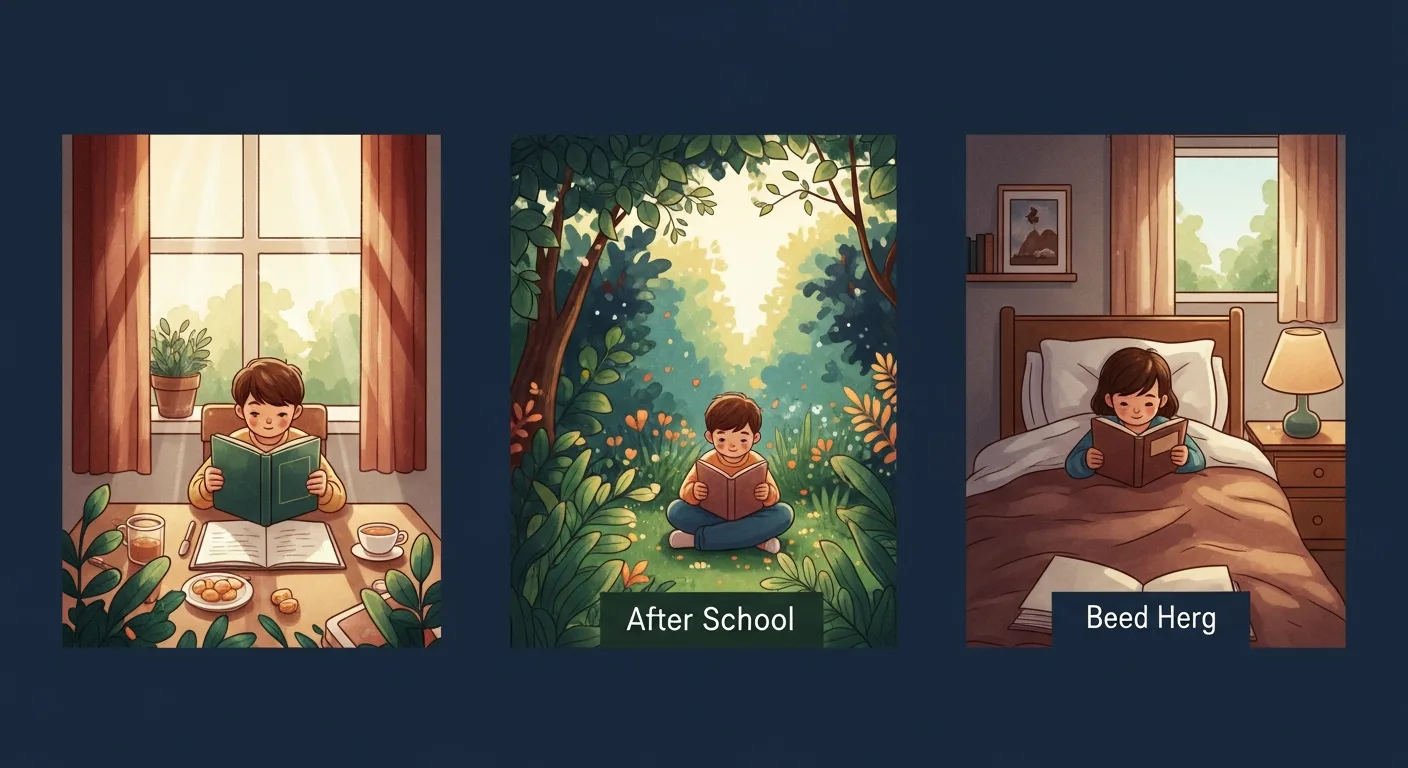
After teeth brushing. There is a reason bedtime reading is the universal default—the toothbrush is a nearly foolproof cue. The moment your child finishes brushing, reading time begins. The sequence becomes automatic faster than you might expect.
After the school bag goes down. An after-school snack plus a chapter creates a decompression ritual that many children come to love. The transition from "school brain" to "home brain" is eased by story.
After dinner, before the evening unravels. For families with variable bedtimes or multiple children at different stages, a post-dinner reading window can be more reliable than the bedtime slot. Everyone is still awake and relatively calm.
The particular anchor matters less than the consistency. Choose one that already happens reliably in your household, and attach reading to it.
Consistency Over Duration
This is worth saying twice, because it runs against our instinct to measure effort in time: a daily five-minute reading habit is vastly more valuable than a weekly forty-five-minute reading session.
Daily repetition does something that weekly binges cannot. It keeps the story alive in both of your minds—you both remember what happened, anticipate what comes next, and carry the characters with you through the day. This ongoing narrative thread is part of what makes reading together so bonding. It is a shared world you inhabit together continuously, not one you visit occasionally.
It also builds the neural pathways that make reading feel natural and automatic. The brain learns through repetition. A child who reads every day—even a little—is building a reader's brain. A child who reads intensively but irregularly is doing something valuable but different.
What to Do on the Impossible Days
There will be days when nothing goes right and story time falls off the edge. When this happens, here is what matters: do not abandon the streak entirely, and do not make the bad day into a story about failure.
On the impossible days, one page counts. Literally one. Read a single page together in a silly voice at an absurd moment—in the car, while someone is getting shoes on, waiting for the microwave. It keeps the chain unbroken without requiring anything you do not have to give.
We explore this idea more in our piece on reading together and family bonding—how small, consistent moments build something much larger than their sum.
Making It Genuinely Non-Negotiable (Gently)
Non-negotiable in a gentle way means that the habit does not disappear when a child protests—but also that the protest is met with warmth rather than force.
Offer choice within the structure. Reading time is happening. What you read is negotiable. This is a powerful combination: the child has genuine agency over the experience, but not over whether the experience occurs. Do you want to continue the chapter book or shall we read one of your picture books tonight? Both options lead to the same place.
Honor the grumble but hold the line. Children sometimes complain about things they actually love, simply because they are tired or overstimulated and the brain reaches for resistance as a default. A warm, cheerful, unsurprised response—I know, you're tired. One page and then we'll see—usually moves through the grumble into the story within minutes.
Make yourself the one who wants it. If reading time is always framed as something you are making your child do, it will always feel imposed. But if you genuinely appear to look forward to it—Oh good, I've been wondering what happens next—it takes on a different flavor. Your enthusiasm is contagious. Your child will catch it.
Tracking Without Pressure
Light tracking can help a reading habit in its early days—not as a performance metric, but as a way of making the invisible visible. When we can see a habit building, we feel the momentum, and momentum is motivating.
The Reading Map
Give your child a hand-drawn map of an imaginary world. Each book, or each week of reading, unlocks a new land. This keeps the emphasis on adventure and exploration rather than achievement. There is no failing to reach a destination on a map—there is only the ongoing journey.
The Story Jar
At the end of each reading session, write the title (or a single word from the story) on a slip of paper and drop it into a jar. Over weeks and months, the jar fills. On a difficult day, pull out a few slips and remember where you have been together. This is not a competition or a chart—it is a memory.
Personalized Story Nights
Periodically, make reading night into something a little more special by pulling out a personalized story—one starring your little hero by name. These nights have a different energy: your child is not just reading a story, they are reading their story. The engagement lifts, the attention deepens, and the memory of that reading session tends to last. At OnceUponMe.com, every story is built around your child—which makes those special reading nights all the more memorable. You can learn more about why personalized stories work so well in our piece on personalized bedtime stories.
Celebrating Reading Milestones
Celebration is not the same as reward. Rewards are transactional—read ten books, get a prize. Celebration is relational—look how far we have come, together.
When your child finishes a chapter book for the first time, make something of it. A special breakfast. A drawing of their favorite character. A dramatic recap told to the other parent or a grandparent. Not a sticker chart item, but a genuine acknowledgment: you did something wonderful, and we noticed.
These small ceremonies tell a child that their reading life is meaningful—not instrumentally, not because it leads to better grades, but because it is a world they are building and inhabiting, and that world deserves to be honored.
The Habit That Becomes an Identity
Here is the long game: you are not just building a reading habit. You are building a reader.
The habit is the mechanism. But what you are really doing, each night in the lamplight, is helping your child understand something about who they are. A child who reads every day, even a little, is a child who thinks of themselves as someone who reads. That identity—I am a reader—will carry them far past the moment they leave your home and your bedtime routine.
It starts with five minutes. It starts tonight.
Every great reading habit deserves a great story to anchor it. At OnceUponMe.com, your little hero is the star of the adventure—a personalized story that makes reading time something they look forward to all day. Create your first story and make tonight's reading one to remember.