Dads and Storytime: Why Father-Child Reading Matters
Dads bring something irreplaceable to storytime. Discover the research behind father-child reading and how to make it your own ritual.
6 min read
Dads and Storytime: Why Father-Child Reading Matters
Picture a classic bedtime story scene. Go on — close your eyes and pull up the image that comes to mind. Chances are, it's a mother. Soft light, a child snuggled in, a woman's voice reading the words. That image is so deeply embedded in our cultural imagination that many dads quietly assume storytime is simply not their department.
It is absolutely their department.
In fact, research suggests that when fathers read to their children, something specific and powerful happens — something that goes beyond what any other reading relationship can replicate. Not because dads are better readers, but because dads tend to read differently. And that difference, it turns out, is the whole point.
What the Research Actually Shows
The science here is worth knowing, because it's genuinely surprising — and genuinely encouraging.
Studies from Harvard and the University of Michigan have found that children whose fathers read to them regularly show stronger language development and higher literacy scores than those read to only by mothers. This isn't a slight against maternal reading — it's a testament to the fact that variety in reading relationships benefits children enormously. Each reading partner brings something different, and the brain thrives on that variation.
A particularly striking finding from a longitudinal study published in the Early Child Development and Care journal found that father involvement in early literacy was one of the strongest predictors of a child's reading level at age nine — independent of the mother's involvement. Not instead of, but in addition to.
More recently, researchers have noted that fathers tend to use more rare words during reading. Where a mother might paraphrase or simplify — adapting intuitively to what the child knows — fathers more often read the text as written, including the unusual vocabulary, and then explain it. That slight challenge stretches a child's language in ways that gentle simplification doesn't.
None of this is to manufacture a competition. It's to say clearly: when dads read, children win.
The Unique Flavor of Dad's Reading Style
Ask anyone who grew up with a dad who read aloud, and a particular quality of memory tends to emerge. Not just the stories — the performance.
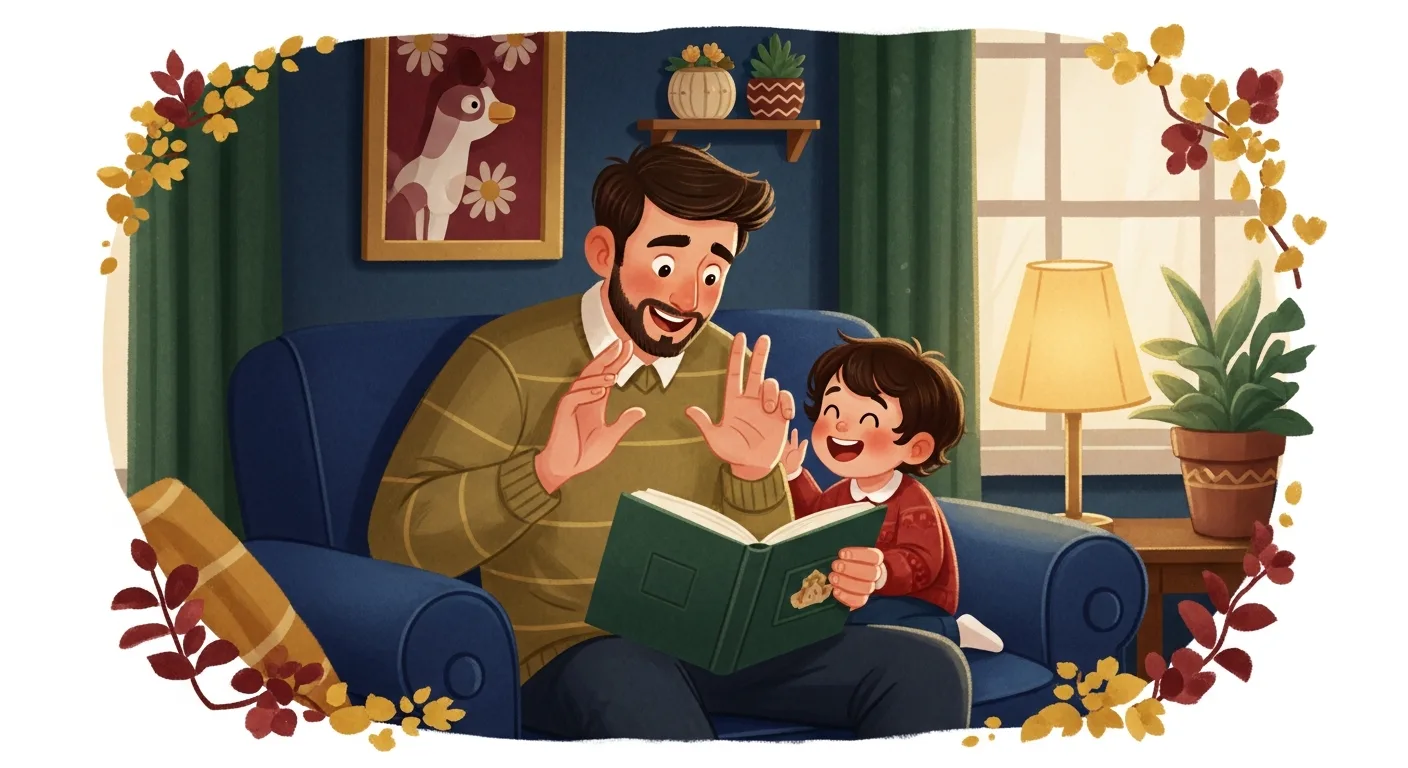
Dads, on the whole, tend to be more theatrical. More willing to do the goblin's voice as genuinely terrifying. More likely to tap the page dramatically at the twist. More inclined to ad-lib, to go off-script, to ask "Wait — what if the dragon and the knight were actually friends this whole time?" and then just... take the story somewhere unexpected.
This isn't every dad, of course. But it's common enough to be notable, and it turns out it's developmentally significant.
Why playfulness in reading matters
When reading is fun — genuinely, unpredictably, laugh-out-loud fun — children associate books with pleasure at a neurological level. The dopamine hit of a dad making a ridiculous sound during a monster chase isn't just a good memory. It's a positive association with literacy that can persist for decades.
There's also something powerful in witnessing a grown man — especially a father, a figure of authority and strength in many families — being completely, unselfconsciously silly over a picture book. That communicates something important: that stories are worth your full self. That there's no performance too big, no voice too weird, no enthusiasm too much when it comes to a good tale.
Your little hero will remember the dragon voice. Trust that.
Breaking the "Mom Reads" Default
If storytime has defaulted to one parent in your household, it's worth pausing to ask how that happened. In most cases, it wasn't a conscious decision. It was habit, convenience, or the path of least resistance — mom was already doing the bedtime routine, so the book naturally landed in her hands.
Changing a default doesn't require a conversation or a family meeting. It just requires a dad picking up a book.
Practical ways to build the habit
Claim a specific slot. Saturday morning stories, or the chapter before lights-out on Friday — pick one recurring time that is yours. Consistency turns a nice idea into a ritual.
Start with a book you actually enjoy. This is more important than it sounds. If you're genuinely interested in the story, your engagement will be infectious. Children are exquisitely sensitive to adult enthusiasm. A dad who's honestly curious about what happens next on page fourteen reads completely differently from a dad dutifully performing a task.
Don't worry about doing it "right." There is no correct way to read a picture book. You can skip pages that drag. You can ask questions you don't know the answer to. You can do the voices badly and get laughed at and do them worse on purpose. The story is a vehicle — the destination is connection.
If they already have a reading parent, don't try to replicate. Be you. Read the way you naturally read. Add your own commentary, your own questions, your own tangents. Your child doesn't need a second version of what they already have. They need you.
Making It a Real Ritual
Rituals are built from repetition and small ceremony. They don't require elaborate setups — they just require showing up in the same way, often enough that the pattern becomes meaningful.
A few things that help storytime become a ritual rather than just a task:
Have a physical "dad reads" book. One book that is currently "in progress" — something longer, read a chapter at a time, that only gets read during your sessions. The ongoing story creates anticipation. Your child will ask about it. They'll think about it during the day. That investment is a beautiful thing.
Create a reading spot. It doesn't need to be fancy — a specific chair, a particular corner of the sofa, even "we sit on the floor with the cushions." Place becomes part of the ritual, and children find enormous comfort in the familiar geography of good things.
Let them see you reading for yourself. This one goes beyond storytime. When children see their fathers reading — for pleasure, for curiosity, because a book is genuinely interesting — they absorb the message that reading is what people do. Not just what children are made to do, but what adults choose to do. That modeling is some of the most powerful literacy education that exists.
Personalized Stories: A Dad's Secret Weapon
Here's something worth knowing: one of the fastest ways to make a child fall completely in love with a story is to make them the main character of it.
Personalized stories — built around your child's actual name, their interests, their world — have a particular kind of pull that even the most beloved off-the-shelf books rarely match. When your little hero hears themselves going on the adventure, solving the problem, befriending the dragon — the engagement level simply goes up.
For dads who are newer to the storytime routine, or who haven't quite found their reading groove yet, a personalized story is a remarkably effective on-ramp. There's no need to do the voices with full commitment when the child is already completely transfixed by the fact that they are in the story.
At OnceUponMe, we build every story around the real details of a real child's life. You tell us about your little hero — their name, the things they love, the kind of adventure they'd want — and we craft a story that is entirely, undeniably theirs. For dads who want to make storytime feel special from the very first session, it's a wonderful place to start.
You can also explore more on building connected reading routines in our post about personalized bedtime stories and how they strengthen the bond between parent and child.
The Long Story
Here is the thing about reading to your children that doesn't get said enough: you will not remember most of the individual stories. Neither will they. What gets remembered — what gets encoded into the emotional architecture of a childhood — is the feeling of being small and safe and loved, tucked next to a parent who chose to be there, in that moment, with a book.
For dads who wonder whether their reading efforts are making a difference: they are. The research confirms it, but you probably don't need research to feel it. You know what it means to a kid when their dad shows up fully for something. Storytime is showing up fully. It's twenty minutes that says, without a single word beyond the story: You are my favorite thing.
That's what the dragon voice is really for.
Start Your Story Tonight
If you're a dad who hasn't quite made storytime your own yet — or if you're a partner who wants to gently nudge a dad in that direction — there's no better night to start than tonight. Pick up a book. Do the voices badly. Ask a silly question about the plot. Let yourself be surprised by how much you enjoy it.
And if you'd like a story where your little hero is already the star, we'd love to make one for you at OnceUponMe. Because every child deserves to hear the story of their own adventure — and there's nobody better to tell it than dad.